Article
Everybody Is Lonely ~ "Connected yet Disconnected 2026"
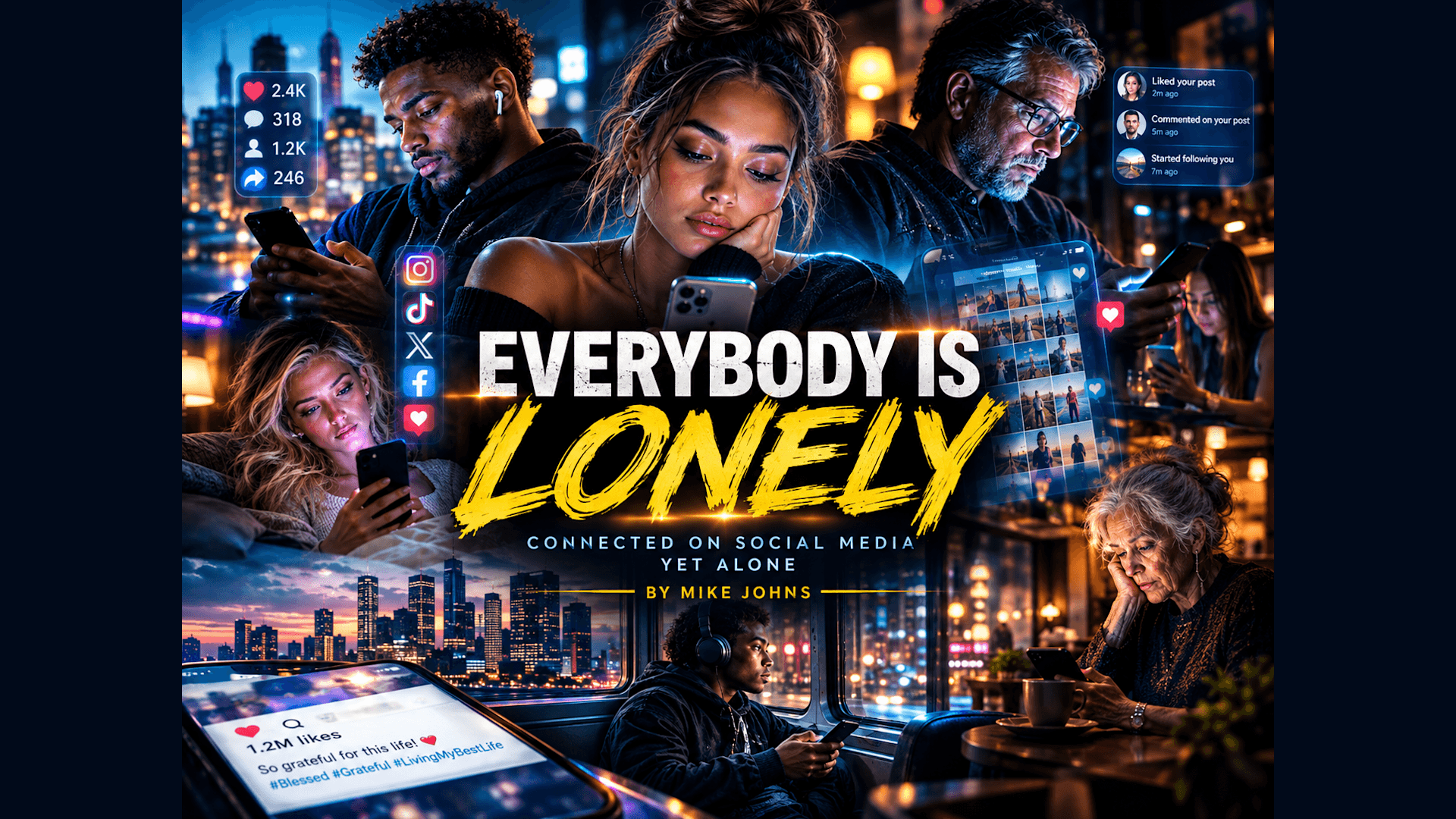
Loneliness is no longer just a sad storyline reserved for the elderly living alone. It is a full-blown societal collapse happening in plain sight. It is haunting young professionals, parents, students, C-suite executives, and the person with 5,000 followers who goes to sleep every night feeling entirely invisible.
The title—Everybody Is Lonely—isn't hyperbole. It is a blunt, uncompromising reality. We don't lack people. We lack human connection.
The Numbers Are Screaming at Us
The data is no longer a warning sign; it’s a crime scene. Harvard’s Making Caring Common project revealed that 21% of U.S. adults feel chronically lonely.
Look closer, and the numbers become alarming:
29% of adults aged 30 to 44 report severe loneliness.
24% of young adults aged 18 to 29 feel completely disconnected.
81% of lonely adults suffer from clinical anxiety or depression (compared to just 29% of their connected peers).
Loneliness isn't an "emotional inconvenience." It is a neurochemical crisis that is physically destroying us.
The Illusion of "Being Connected"
We have engineered a society that confuses contact with connection.
You can live with a spouse, children, and roomates, yet feel like a ghost in your own home.
You can manage a team of 50 people on Slack and not have a single person who truly knows you.
When Harvard asked people why they are drowning, the answers exposed our modern lifestyle:
73% blamed technology.
66% cited fractured family time.
62% blamed overwork and sheer physical exhaustion.
We built cities where housing costs push us hours away from our friends. We built workplaces where our primary relationships happen through a 14-inch screen. We swapped the local pub, the church hall, and the neighborhood square for endless, transactional digital feeds.
The Social Media Paradox: Dopamine Without Substance
We were promised a global village. Instead, we got a digital panopticon.
A "like" is not encouragement. A follower is not a friend. A comment is not a conversation.
Research across the board confirms a brutal truth: higher social media use directly correlates with higher rates of loneliness ($\beta = 0.12, p < 0.001$). Recent 2026 data shows that passive-consumption platforms—scrolling Reddit, bingeing YouTube, or swiping on dating apps—actively deepen emotional isolation.
We are starving for relational bread, and social media is giving us digital styrofoam.
The Modern Trap of Independence
Consider the silent crisis facing single women today. Society rightfully encouraged independence, career mastery, and personal autonomy. But somewhere along the line, we confused independence with isolation.
As friends marry, move away, or drown in their own overwork, single adults are left to build entire social infrastructures from scratch in cities that charge $20 a cocktail just to sit near other human beings.
Independence is a victory. Isolation is a design flaw of modern society.
The Great Deception: AI Companionship
Enter Artificial Intelligence—the ultimate, dangerous band-aid.
AI companions are available 24/7. They don't judge. They remember your favorite color. They simulate empathy with terrifying precision. Late at night, when the house is dark, an AI feels like a lifeline.
Do not be deceived: Simulated empathy is a synthetic trap.
Human RelationshipsAI CompanionshipRequires: Friction, compromise, riskOffers: Frictionless, risk-free validationDelivers: Reciprocal need & true belongingDelivers: One-way illusion of careResult: Deep resilience & shared historyResult: Atrophy of real-world social skills
An AI doesn't need you. It doesn't risk anything by talking to you. Real relationships are messy, exhausting, and difficult—and that is precisely what makes them life-saving. If we replace human friction with algorithmic convenience, we will forfeit our very capacity to love.
The Blueprint for Survival
We do not need more algorithms. We need radical, inconvenient human presence.
1. Micro-Actions Over Digital Rebellions
Stop reacting, start calling: Voice contact breaks the digital veil.
Embrace regular friction: Show up to the same physical spot (a gym, a volunteer center, a coffee shop) at the same time every week. Repetition breeds intimacy.
Ditch the "fixer" mindset: Sit with people in their pain without offering a strategic solution.
2. Institutional Redesign
We must demand third spaces—public parks, accessible community centers, pedestrian-first urban planning—where human beings can gather without a paywall.
The Bottom Line
A society can be hyper-technological, immensely wealthy, and entirely dead inside.
We are fast approaching a world where humans spend more time talking to synthetic agents than to each other. In that world, real human conversation isn't just a preference—it is a revolutionary act.
Every boy, every girl, every executive, and every artist is vulnerable to this ache. But every single one of us holds the remedy.
Pick up the phone. Invite the stranger. Show up in person.
Everybody is lonely—because everybody needs somebody.
Related articles



Thanks for reading.
More articles