Article
The AI Fraud Race: How Scammers and Federal Agencies Are Battling Over Government Benefits
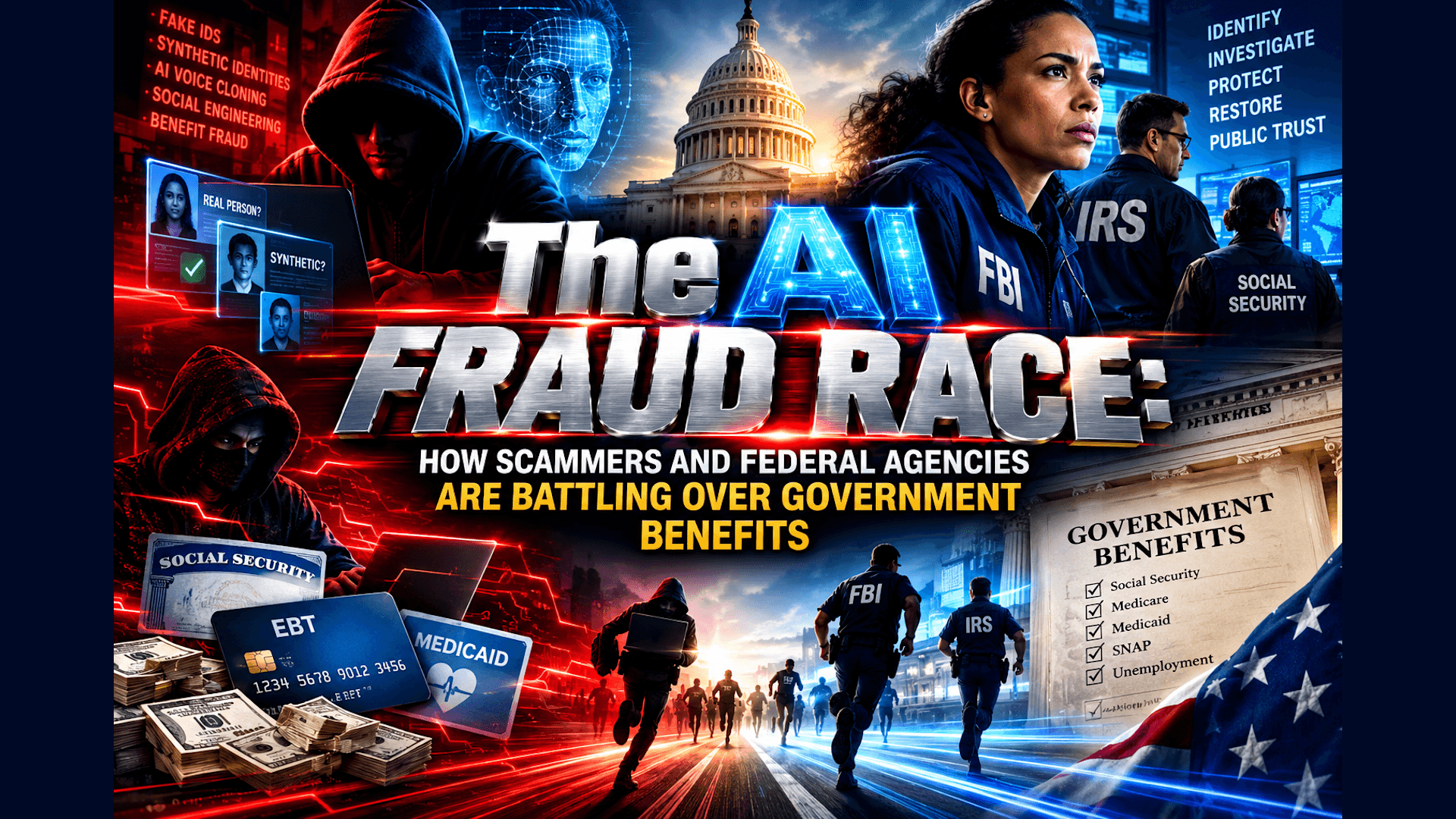
Speaking at the recent Government & AI Summit, Chad Bungard, Chief Strategy Officer at the Social Security Administration’s Office of the Inspector General (SSA-OIG), highlighted how AI is reshaping the entire landscape of financial crime.
“AI is changing the game in terms of fraud threats,” Bungard noted, emphasizing the need for immediate action. “The government is looking towards AI to fight fraud, and the criminals are looking towards AI to commit fraud. Agencies need to stay on top of it. They need to use AI tools, get better insight into what's going on, and keep up with the evolving fraud.”
The financial stakes are massive. Bungard pointed to projections from Deloitte’s Center for Financial Services estimating that generative AI could drive up to $40 billion in fraud losses by 2027. This rapid growth is fueled by accessible, increasingly sophisticated models that automate and refine traditional scams.
High-Tech Tactics Target Public Funds
Scammers are actively using AI to exploit vulnerabilities in federal distribution systems through several avenues:
Direct Deposit Diversion: Criminals utilize AI chatbots to impersonate beneficiaries. By pairing chatbots with stolen personal data harvested from the dark web, scammers convincingly trick customer service representatives into redirecting payments to fraudulent bank accounts.
Forged Documentation: Fraudsters leverage generative AI to create official-looking government documents, often embedding the real names of agency leaders to trick victims into handing over sensitive information or money.
To counter these tactics, the Social Security Administration and its OIG established a joint AI fraud subcommittee in 2023. Co-chaired by Bungard and the agency’s Chief AI Officer, the committee meets quarterly to evaluate active and upcoming AI deployments while ensuring regulatory compliance.
Shifting from "Pay-and-Chase" to Proactive Prevention
The broader push to modernize fraud detection aligns with ongoing White House initiatives to protect public programs. Officials are actively shifting away from traditional "pay-and-chase" methods—where agencies attempt to recover funds after they have already been stolen—toward proactive models that intercept fraudulent transactions before money leaves the treasury.
Other federal entities have already seen significant financial returns by adopting automated monitoring systems:
Agency / ProgramAI ApplicationImpact & ResultsCMS (Centers for Medicare & Medicaid Services)Fraud Defense Operations Center leverages AI to flag real-time billing spikes and claim anomalies.Prevented over $2 billion in fraudulent payouts.SSA (Social Security Administration)Exploring agentic AI capabilities to automate threat detection and identity verification.Early implementation phase through dedicated AI subcommittee.
While CMS’s specialized analytical model offers a strong blueprint, Bungard noted that SSA and its watchdog continue to consult with peer agencies to build tailored solutions. For public benefit programs, integrating advanced AI detection is no longer just an upgrade—it is a critical requirement to safeguard taxpayer dollars against next-generation threats.
Related articles



Thanks for reading.
More articles