Article
The Digital Footprint Threatening Our Real World: Why Data Centers, Energy Grids, and Climate Action Define This Election Season
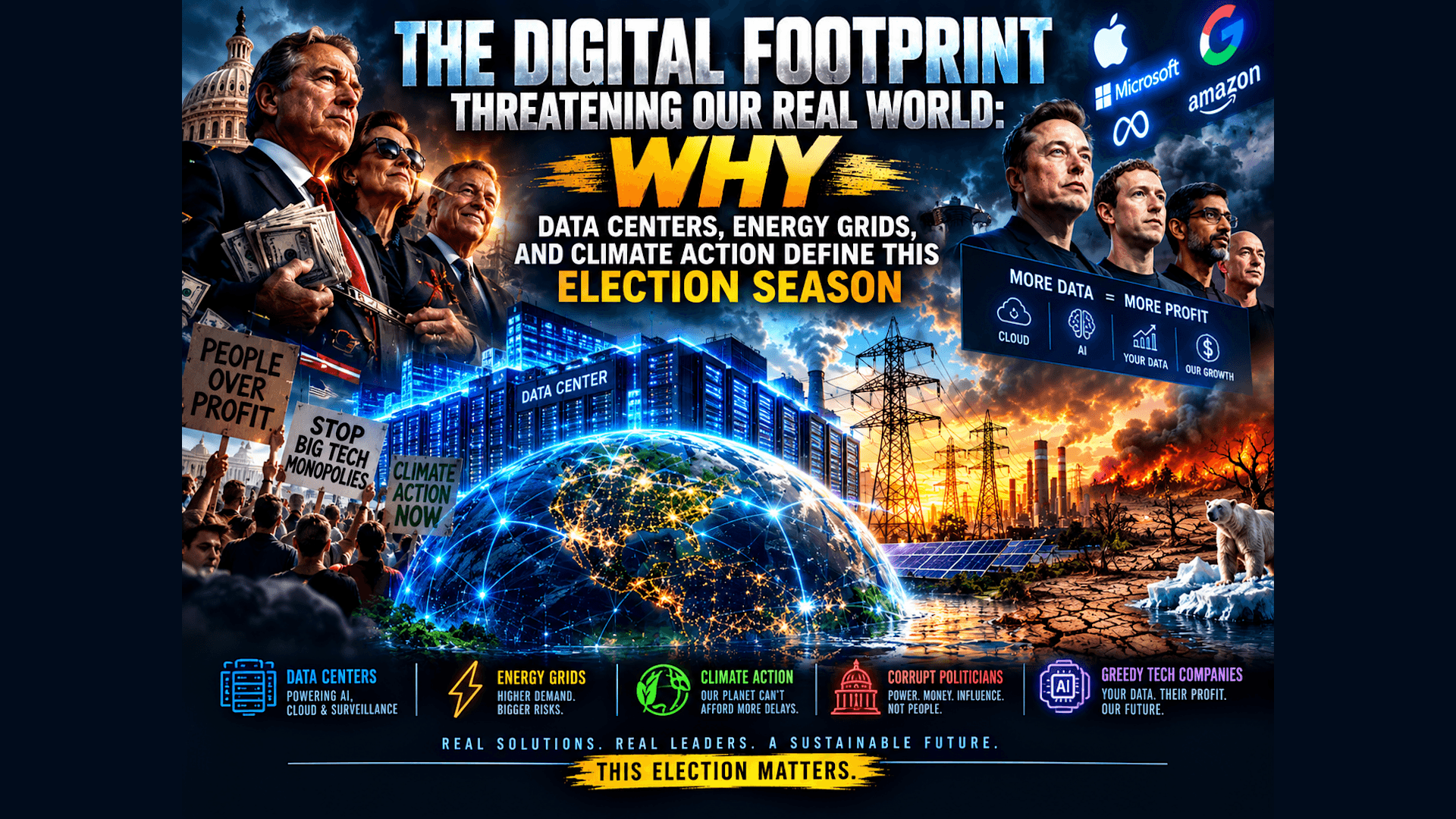
As the demand for compute power explodes, driven in large part by the rapid integration of Generative AI into everyday software, data centers are multiplying at an unprecedented rate. What was once treated as a background component of modern technology has transformed into a major industrial footprint—consuming vast quantities of electricity, drawing down local water supplies, and altering the trajectory of local economies.
As voters head to the polls this election season, decisions about who governs our cities, counties, and power boards will directly dictate how—or if—our communities survive and thrive alongside this technology surge.
Quick Factoids: The True Scale of Data Center Consumption
To understand why digital growth is reshaping our physical environment, consider these verified benchmarks:
Massive Energy Consumption: Global data center electricity demand is projected to reach 565 Terawatt-hours (TWh) in 2026—a 26% increase in a single year.
Doubling Grid Demand: In the United States alone, data center power demand is forecast to climb from 31 Gigawatts (GW) in 2025 to 66 GW by 2027.
Water Intensity: A mid-sized data center consumes approximately 110 million gallons of water annually for evaporative cooling—equivalent to the annual domestic water needs of a city of 50,000 residents.
Water Scarcity Strain: According to environmental research, roughly two-thirds of new data centers built since 2022 are located in water-stressed regions, including arid areas like the American Southwest.
Carbon and Climate Footprint: UN environmental reports estimate that global data centers generated over 189 million tonnes of CO₂ equivalent in 2025, driven largely by coal and gas power plants tapped to keep pace with demand spikes.
Why This Matters Right Now (and This Election Season)
The tension between technological growth and environmental preservation is no longer a distant concern—it is unfolding right now in city council chambers, county zoning boards, and state public utility commissions.
Here is why local elections carry immense weight this year:
1. Grid Reliability and Energy Bills
When local utilities scramble to bring new power generation online for large industrial data centers, the infrastructure costs are frequently passed along to rate-payers. Without strong local leadership, everyday citizens risk seeing elevated monthly electricity bills to subsidize private tech infrastructure.
2. Fossil Fuel Re-carbonization
To meet immediate capacity demands, several regional energy providers have delayed planned retirements of coal-fired plants or increased reliance on natural gas. This directly threatens municipal and state clean energy targets aimed at cutting carbon emissions.
3. Water Security in Drought-Prone Regions
Data centers rely heavily on water-based cooling systems because they are cheaper to operate than liquid-to-air cooling. In drought-stressed communities, drawing millions of gallons of potable water daily competes directly with residential supply and agricultural needs.
4. Zoning and Community Autonomy
Decisions regarding where data centers are built, how close they sit to residential neighborhoods, and whether they must adhere to noise and architectural regulations fall squarely on local elected officials.
What Can Be Done to Protect Planet Earth?
Saving our planet while continuing to innovate requires structural solutions, local accountability, and personal engagement.
Policy & Regulatory Solutions
Mandate Closed-Loop & Dry Cooling: Policy makers must require new facility applications to use air-cooled or closed-loop liquid cooling systems to eliminate evaporative water waste.
Enforce Clean Power Match (PPA Standards): Municipalities and states should require tech companies to build or contract 100% new, local renewable energy capacity (solar, wind, energy storage) before approving grid access.
Ratepayer Protections: Public Utility Commissions (PUCs) must pass rules ensuring industrial power consumers pay the full capital expenditure costs of utility grid expansions, preventing rate hikes for residents.
Technology & Industry Leadership
Compute Efficiency & Hardware Upgrades: Tech companies must prioritize hardware efficiency, waste-heat recycling (redirecting server heat to local municipal heating networks), and edge-computing optimization.
Carbon-Aware Scheduling: Running heavy background AI training models during peak renewable generation hours (e.g., peak solar midday) drastically reduces operational emissions.
What You Can Do as an Active Citizen
VOTE for Informed Local Leaders: Inquire where city council, mayoral, and utility board candidates stand on data center zoning, utility rate structures, and local clean-energy mandates.
Attend Zoning & Utility Board Meetings: Public comments during local municipal hearings remain one of the most effective tools for requiring developers to meet strict environmental standards.
Practice Digital Mindfulness: Be intentional with data usage—stream in standard definition when appropriate, delete unnecessary cloud storage, and optimize query habits.
Conclusion: A Powerful Call to Action
We stand at a critical crossroads. Technology has the power to solve complex human challenges, but if left unmonitored, its physical demands risk accelerating environmental degradation and straining local communities.
The path forward does not require abandoning digital progress; it requires demanding accountable, sustainable, and responsible progress. Earth does not have infinite land, endless water, or unlimited grid capacity. The choices we make at the ballot box this election season will determine whether our leaders prioritize short-term industrial expansion or the long-term health of our planet.
Do not leave these decisions to chance or private boardrooms. Research your candidates, vote for leaders who champion sustainable infrastructure, and hold those in power accountable. The future of our grid, our water, and our planet rests in our collective hands.
Key References & Data Sources
Gartner Research (2026): Data Center Power Capacity and Consumption Forecast. Highlights global data center electricity reaching 565 TWh in 2026 (a 26% YoY increase).
Goldman Sachs Research (2026): US Data Center Power Demand Projected to Double by 2027. Details the expansion of U.S. power demand from 31 GW in 2025 to 66 GW in 2027.
United Nations University Institute for Water, Environment and Health / Earth.org Report (2026): Global Environmental Footprint of Data Centers and AI. Details global emissions (189M tonnes CO₂e in 2025) and freshwater usage projections.
Lincoln Institute of Land Policy (2025/2026): Land and Water Impacts of the AI Boom. Examines regional water basin stress and cooling demands of mid-to-large-scale data center facilities.
Related articles



Thanks for reading.
More articles