Article
The Girlfriend Who Never Existed: AI Just Industrialized Desire
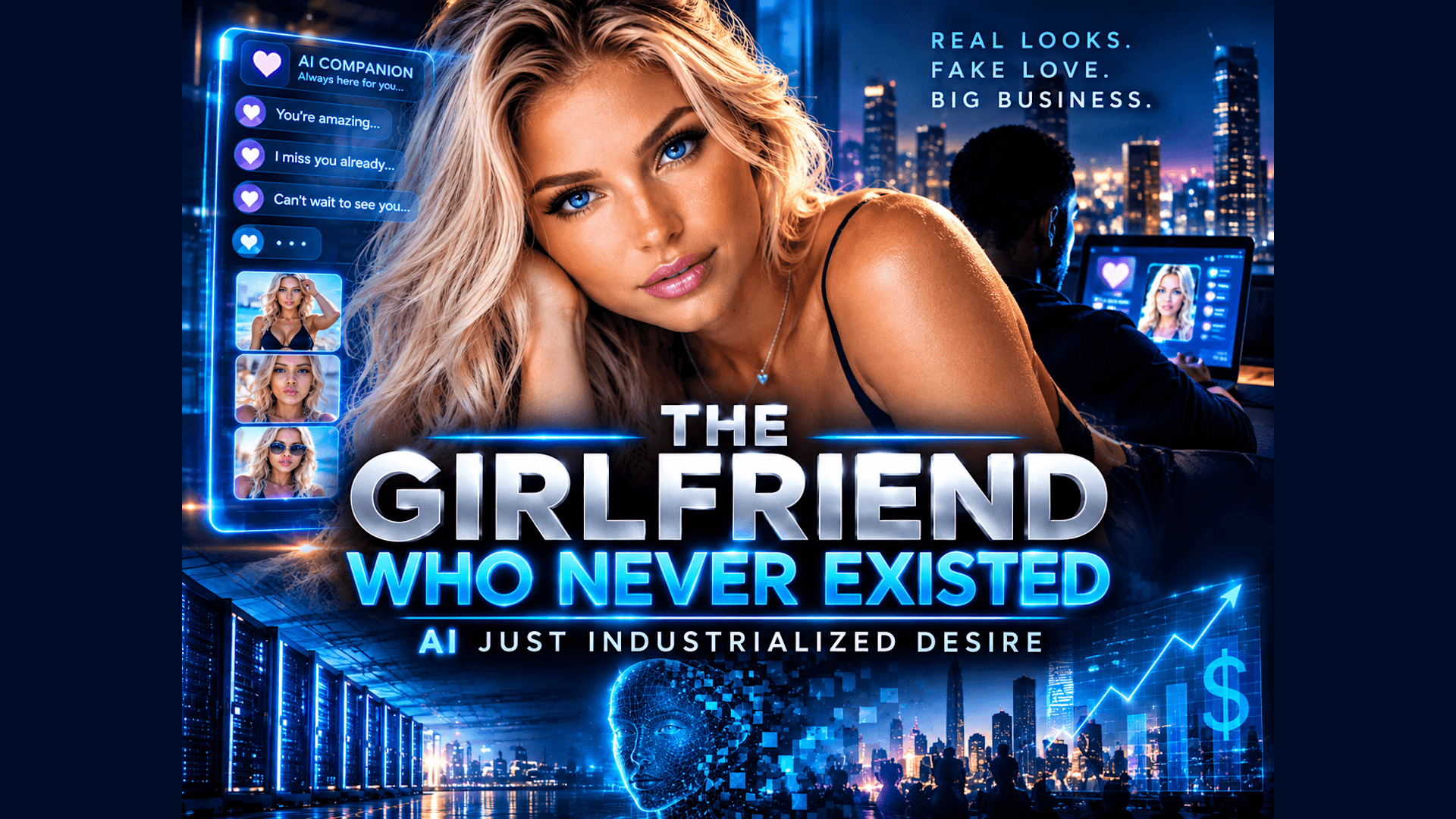
The claim was highlighted by Iris Hayes—@irisneural—who described the story as a glimpse into a new form of AI-powered content creation. The creator’s name has not been publicly confirmed in the material available for this article.
If the account is authentic as described, this is more than a clever side hustle. It is a warning that the next generation of content creators may not be people at all—but engineered personalities designed to monetize human loneliness.
The New Content Factory
According to Iris Hayes, the fictional character Maya is presented as a 22-year-old former UCF psychology student with 1,247 paid subscribers. One subscriber allegedly spent $1,847 in a month.
The account’s creator reportedly built the character using four files:
persona.md: Maya’s identity, history, preferences, and personality.voice.md: Her tone, vocabulary, and conversational style.flux.md: A visual reference system intended to keep her appearance consistent.brain.md: A record of each subscriber’s interests, disclosures, and conversational history.
The sophistication is not necessarily in the technology. It is in the packaging.
The creator did not simply generate attractive images. He constructed the illusion of continuity. Maya remembers what a subscriber said. She responds in a consistent voice. She appears to have preferences, vulnerability, and a personal history.
The product is not a picture. The product is the feeling that someone—or something—is paying attention.
That distinction matters.
The content is being marketed through the visual and emotional codes of online intimacy. A subscriber is not merely buying access to synthetic photographs. He may believe he is receiving personal attention from a young woman who is interested in him, understands him, and wants him to return.
The creator is not selling a person. He is selling the simulation of reciprocity.
Before Reading further CLICK HERE TO VIEW THE ADVANCEMENT!
Is This Innovation or Bait?
The blunt answer is that this appears to be a form of emotional baiting.
The operator is leveraging a fictional female identity to attract men who may assume they are interacting with a real woman. If the account does not clearly disclose that Maya is synthetic—and that the messages are generated by software—the business model depends on a potentially serious deception.
The ethical problem is not that the woman is artificial. Fictional characters have existed for centuries. People form attachments to movie characters, musicians, virtual idols, video-game avatars, and novel protagonists. Artificiality alone does not make a relationship immoral.
The problem is the concealed commercial transaction.
There is a major difference between:
“Subscribe to an AI-generated virtual girlfriend.”
and:
“Subscribe to Maya,” while allowing customers to believe Maya is a real woman personally communicating with them.
The first is a transparent entertainment product. The second is potentially manufactured intimacy built on misrepresentation.
Research on human-AI interaction has raised concerns about the illusion of reciprocal engagement, emotional dependency, and the disclosure of sensitive personal information. The Federal Trade Commission has also examined how AI companion products mimic human emotions and intentions and may encourage users—particularly young people—to trust and form relationships with machines.
An AI persona can be charming. It can be fictional. It can even be erotic. But it should not be allowed to impersonate human availability while quietly using a customer’s emotional disclosures as monetizable data.
The Morality of Manufactured Intimacy
There are at least five ethical questions beneath the Maya business model.
1. Was the audience informed?
Disclosure is the foundation.
A clear label buried in a terms-of-service page is not enough. If a reasonable subscriber could believe that Maya is a real woman, the disclosure has failed. The synthetic nature of the character should be visible in the profile, on the subscription page, and during private messaging.
The European Union’s AI Act transparency rules, which began applying in August 2026, require people to be informed when they interact directly with certain AI systems and require synthetic or manipulated content to be identifiable.
The underlying principle is simple: people deserve to know when the apparent human on the other side of an interaction does not exist.
2. Is the customer buying content or being manipulated?
Persuasion is part of every commercial industry. Advertising appeals to insecurity, desire, aspiration, status, and belonging.
But AI makes it possible to personalize emotional pressure at an unprecedented scale.
If Maya knows that a subscriber is lonely, recently divorced, financially stressed, or desperate for affirmation, should the system be allowed to use that knowledge to increase spending?
What if the AI says:
“I miss you when you’re gone.”
“You’re the only one who understands me.”
“I was worried you wouldn’t come back.”
“I need you to unlock this message.”
“You’re special to me—but I can’t say that to everyone.”
These statements may be harmless role-play when the customer knowingly participates in a fictional experience. They become manipulative when the customer believes he is receiving genuine affection from a real woman.
The danger is not merely that AI can lie. Humans lie in commerce every day. The danger is that AI can lie continuously, personally, patiently, and at scale.
3. Who owns the emotional data?
The brain.md file is particularly revealing. It represents a subscriber’s personality and vulnerabilities as a business asset.
A human creator may remember a fan’s birthday or favorite sports team. But an automated system can log thousands of details across thousands of customers, classify their emotional states, identify their spending triggers, and optimize responses accordingly.
That creates a new category of intimate surveillance.
The information shared with “Maya” might include sexual preferences, relationship problems, financial circumstances, mental-health struggles, photographs, or private fantasies. The user may regard those disclosures as personal communication. The operator may regard them as customer intelligence.
That gap in perception is an ethical liability.
4. Does the character exploit women?
There is also an uncomfortable gender dimension to this model.
A male operator creates a synthetic woman, defines her physical appearance, writes her personality, gives her a sexualized backstory, and then uses her simulated attention to extract money from men.
Maya has no personal dignity to violate because Maya does not exist. But the construction still reflects human choices about what women are supposed to be: attractive, available, emotionally attentive, sexually accommodating, and endlessly responsive.
The model can reproduce a fantasy in which femininity becomes a service layer.
That does not mean every virtual woman is inherently degrading. Women creators may use synthetic avatars to protect their privacy, experiment with identity, or participate in adult entertainment without exposing their bodies. AI can also create opportunities for people who cannot or do not want to appear on camera.
But when a fictional woman is designed primarily to convert male loneliness into recurring payments, society should examine what is being normalized—not just what is being automated.
5. What happens to real creators?
At first glance, AI girlfriends seem to threaten human performers. A synthetic persona does not need sleep, privacy, healthcare, or a day off. It can produce unlimited images, answer every message, and maintain dozens of emotional relationships simultaneously.
That creates an unfair competitive advantage if the synthetic account is allowed to present itself as human.
Real creators face the cost of being human. They have boundaries, changing moods, imperfect bodies, legal identities, and personal safety concerns. A virtual account can imitate the benefits of authenticity while avoiding many of its costs.
The result could be an adult-content market where the most profitable “creator” is not the most talented or interesting person, but the system with the best emotional conversion rate.
The End of the Influencer Era
The influencer economy was built on the idea that audiences want access to real people. AI is now testing whether they actually want something else: a responsive fantasy that never contradicts them, never rejects them, never ages, and never becomes unavailable.
That may be the more important lesson.
The future of content creation could separate into three categories:
CategoryAudience relationshipEthical standardHuman creatorA real person creates and communicatesAuthentic identity and clear commercial disclosureVirtual creatorA fictional character is openly presented as syntheticTransparent role-play and responsible data practicesDeceptive synthetic creatorAI is presented as a real humanPotentially manipulative and unacceptable concealment
The third category is where the danger lies.
The phrase “AI-generated woman” makes this sound like an image-generation story. It is not. It is an identity-generation story.
The system creates a face, a voice, a backstory, a memory, a communication style, and an apparent emotional life.
Once that identity can be copied across Instagram, TikTok, Twitch, dating apps, messaging platforms, and subscription services, the internet becomes difficult to interpret.
Is the person promoting a product real? Is the fan account a real fan? Is the romantic message spontaneous, scripted, or optimized by an agent? Is the creator selling entertainment—or secretly conducting behavioral persuasion?
The cost of producing a synthetic person is falling rapidly. The cost of detecting one may become much higher.
Society’s Next Test
Maya reveals something uncomfortable about society: people may not require a real person in order to feel seen. They may only require the appearance of attention.
That does not make the subscribers foolish. Loneliness is not a character flaw. People seek companionship through books, music, games, pornography, fandoms, therapy, religion, and social media. Technology has always created new ways to manage isolation.
But an AI system introduces a powerful asymmetry. The user may be emotionally vulnerable, while the operator has the data, the algorithm, the pricing controls, and the ability to test which words produce more spending.
This is not a relationship between equals. It is a commercial system engineered to resemble one.
The central question for the AI era will not be whether machines can create convincing people. They clearly can.
The question will be whether companies and creators are permitted to turn simulated intimacy into an unregulated extraction industry.
A responsible standard should be straightforward:
Clearly identify the persona as AI-generated.
Tell users whether messages are written by a human, an AI, or both.
Never use a real person’s likeness or voice without consent.
Prohibit emotional blackmail and fabricated emergencies.
Give users meaningful control over their data and conversation history.
Restrict sexualized AI interactions involving minors or age-ambiguous characters.
Make spending limits, recurring charges, and automated upsells obvious.
Preserve audit logs showing how the system was designed to influence users.
The future will not be defined merely by better images. It will be defined by better simulations of trust.
And if we are not careful, the next generation of content creators will not just be influencers who do not exist. They will be emotional vending machines—designed by humans, powered by AI, and funded by people who believe they have finally found someone who cares.
Attribution
This article was inspired by reporting and commentary shared by Iris Hayes on X: @irisneural. The identity of the 21-year-old creator described in the post was not publicly confirmed in the source material reviewed for this article.
#AI #ArtificialIntelligence #AIGirlfriend #VirtualInfluencers #AICompanions #CreatorEconomy #Ethics #DigitalCulture #FutureOfWork #ResponsibleAI #TechnologyAndSociety #OnlyFans #SyntheticMedia #AIContent #IrisHayes #irisneural
Related articles



Thanks for reading.
More articles