Article
Waymo vs. Tesla: Let the Ride Begin!
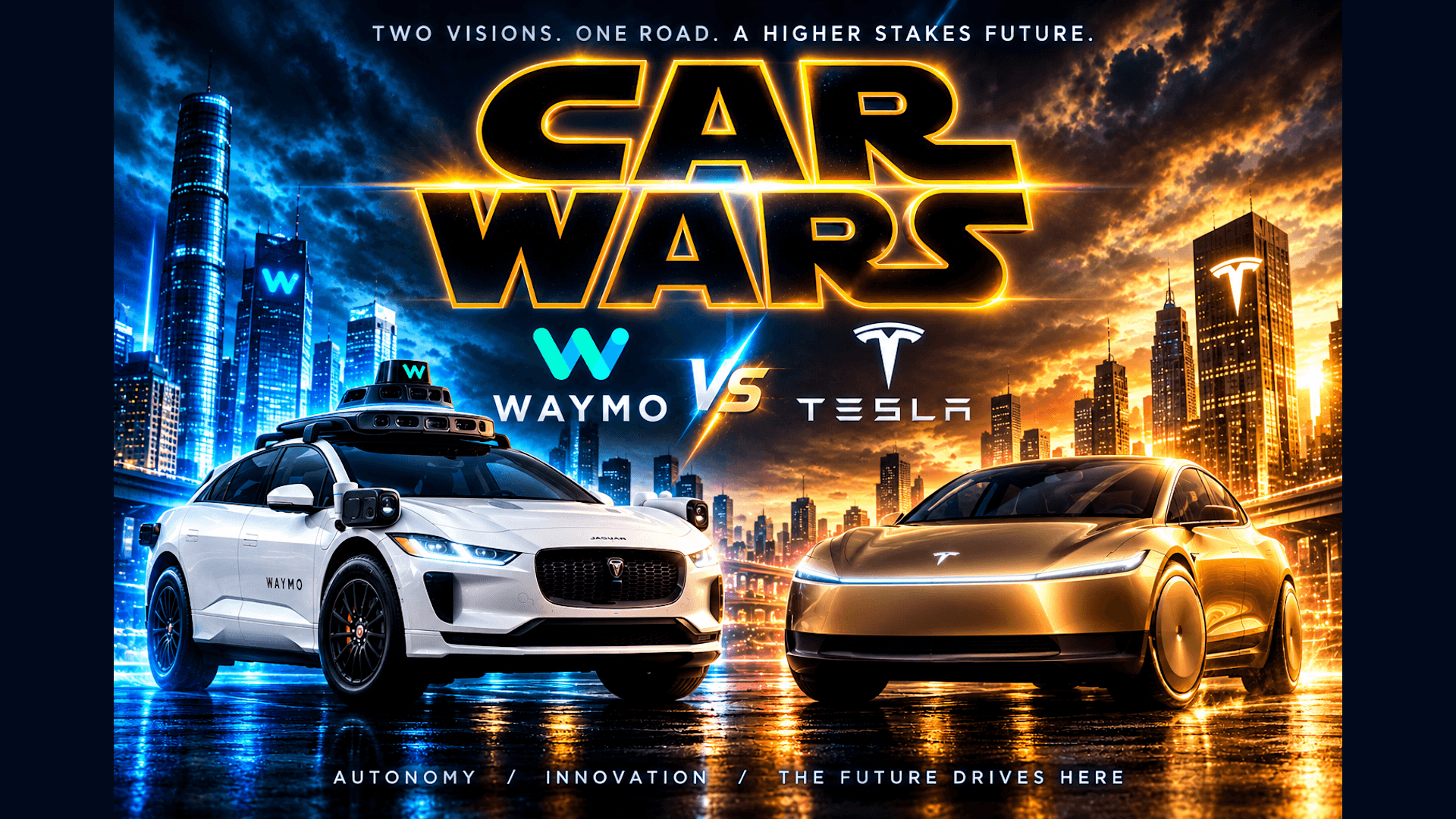
Tesla’s Cybercab launch in Austin, Texas, has intensified that competition. The two-seat vehicle is designed without a steering wheel, accelerator, brake pedal, or conventional mirrors. Tesla has presented the Cybercab as a purpose-built autonomous taxi that could eventually make transportation cheaper, more efficient, and widely available. However, federal regulators opened an investigation shortly after the launch to examine the process and technical data Tesla used to certify the vehicle.abc7news
Waymo, meanwhile, represents a different strategy: deploy autonomous vehicles gradually, operate within defined service areas, use extensive sensor systems, and expand only after accumulating real-world experience. The contest is therefore about more than two companies. It is a test of competing philosophies about safety, scale, cost, regulation, and public trust.
Two Different Roads
Waymo’s approach is built around a carefully controlled operational design domain. Its vehicles use a combination of cameras, radar, lidar, mapping, software, and onboard computing to navigate without a human driver in approved locations and conditions. Waymo has argued that fully autonomous driving requires a combination of sensors rather than relying exclusively on cameras and artificial intelligence.techcrunch
Tesla has pursued a more streamlined philosophy. The company has emphasized cameras, neural networks, and software trained on data collected from a large vehicle fleet. Elon Musk has repeatedly criticized lidar as unnecessary, describing it as a costly limitation rather than an essential component of autonomy.techcrunch
The result is a fundamental technology debate:
Issue
Waymo
Tesla Cybercab
Vehicle concept
Retrofitted or purpose-adapted autonomous vehicles
Purpose-built two-seat robotaxi
Sensor strategy
Cameras, radar, lidar, mapping, and redundancy
Primarily camera-based perception and AI
Human controls
Vehicles generally retain traditional controls
Cybercab is designed without steering wheel or pedals
Deployment model
Geofenced, city-by-city expansion
Ambitious fleet-scale expansion using Tesla’s manufacturing platform
Primary advantage
Operational experience and sensor redundancy
Potentially lower cost and greater manufacturing scale
Main challenge
Expensive hardware and complex fleet operations
Safety validation, regulatory approval, and public confidence
This comparison should not be reduced to “old technology versus new technology.” Waymo’s sensor-heavy system may be more expensive, but redundancy can help a vehicle interpret difficult conditions such as darkness, glare, rain, construction zones, and unusual road activity. Tesla’s simpler hardware architecture could eventually reduce vehicle costs, but it places greater pressure on software performance, training data, validation, and regulatory confidence.
Why the Cybercab Matters
Tesla’s Cybercab is important because its design makes a bold statement: if the vehicle is truly autonomous, why should it need equipment intended for a human driver?
That question has significant legal and safety implications. According to the reporting on the federal investigation, NHTSA is examining whether Tesla properly certified Cybercabs under existing federal motor-vehicle safety standards, many of which were written around vehicles operated by human drivers. The agency is also examining the technical data and certification process behind the deployment.abc7news
The investigation does not, by itself, determine that the Cybercab is unsafe or unlawful. It does show that autonomous vehicles are developing faster than some existing rules and regulatory frameworks. Policymakers must now determine how to evaluate vehicles that are not designed for a person to drive at all.
The issue is bigger than steering wheels and brake pedals. Regulators must consider:
How should autonomous vehicles be tested before public deployment?
What evidence should companies provide to prove safety?
Who is responsible when an autonomous vehicle makes a critical decision?
How should emergency responders interact with a vehicle that has no driver?
What protections should passengers have during a software failure?
How transparent should companies be about crashes, disengagements, and system limitations?
The answers will influence whether the public sees robotaxis as a reliable transportation service or as an uncontrolled experiment on public roads.
The Austin Test
Austin has become an important proving ground for the robotaxi industry. Tesla’s Cybercab launch places its futuristic vehicle in the same broader market where Waymo has been building experience with autonomous rides.
The Cybercab’s two-seat design could create efficiency advantages for individual passengers or couples. It may also reduce manufacturing complexity and operating costs if Tesla can produce the vehicle at high volume. But the limited seating capacity could make the Cybercab less practical for families, groups, travelers with large luggage, or riders who need accessibility features.
Waymo’s more conventional vehicle design may be less visually dramatic, but passengers may find it familiar. A larger vehicle can accommodate more types of riders and use cases. At the same time, Waymo’s approach requires more expensive sensors and specialized equipment, potentially making each vehicle costlier to build and maintain.
This creates two different visions of scale:
Tesla wants to make autonomy inexpensive by producing millions of relatively simple vehicles.
Waymo wants to make autonomy dependable by combining specialized hardware, detailed mapping, operational controls, and measured expansion.
The winner may not be the company with the most impressive demonstration. It may be the company that can deliver the best combination of safety, availability, affordability, customer experience, and regulatory compliance.
The Level 5 Question
Both companies operate in the shadow of a powerful phrase: Level 5 autonomy.
Under the SAE framework, Level 4 systems can perform the entire driving task without human intervention within a defined operational design domain. Level 5 autonomy would remove those boundaries and allow the vehicle to operate everywhere, in all conditions where a human could drive. Waymo’s system is generally described as Level 4 because its service remains limited by location, road conditions, weather, and other operating parameters.engadget
That distinction matters. A vehicle can be completely driverless during a ride and still not be Level 5.
A Waymo passenger may sit in the back seat without monitoring the road, but the ride occurs inside a specific area where the system has been designed and validated to operate. Tesla’s Cybercab may also be fully driverless in its initial service, but a limited Austin deployment would still represent geofenced autonomy rather than universal Level 5 capability.
The pursuit of Level 5 is valuable as a long-term goal, but the public should judge today’s services by practical performance:
Does the vehicle safely complete trips?
Does it handle unexpected situations?
Can it operate in challenging weather and lighting?
Does it provide reliable assistance when something goes wrong?
Can it serve people with disabilities, children, older adults, and riders with different needs?
Can it earn public trust at a price people can afford?
The transportation revolution will be measured by reliable rides—not by a label alone.
Why This Matters
The Waymo-Tesla race matters because autonomous transportation could reshape much more than the taxi industry.
For consumers, robotaxis could reduce transportation costs, expand mobility for people who cannot drive, and provide safer alternatives to impaired or distracted driving. For cities, autonomous fleets could change parking demand, curb management, traffic patterns, and public-transit planning.
For workers, the transition could create new opportunities in fleet operations, remote assistance, vehicle maintenance, data analysis, cybersecurity, customer support, mapping, and autonomous-system oversight. It could also disrupt driving-related occupations, making workforce preparation and reskilling essential.
For businesses, autonomous vehicles could produce new models for logistics, hospitality, tourism, retail, sports venues, and entertainment. Imagine a future in which a robotaxi becomes more than transportation: it could serve as a mobile workspace, media platform, advertising channel, or personalized digital environment.
For policymakers, the challenge is to encourage innovation without allowing companies to treat public roads as unregulated laboratories. Safety standards, reporting requirements, accessibility rules, insurance systems, cybersecurity protections, and privacy policies must evolve alongside the technology.
Most importantly, this competition will shape public perception. A single serious incident, unexplained malfunction, or poorly managed launch could damage confidence in the entire autonomous-vehicle sector. Conversely, consistent service, transparent reporting, and responsible oversight could accelerate adoption.
Conclusion: The Ride Has Begun
Waymo and Tesla are taking different paths toward the same destination. Waymo is emphasizing sensor redundancy, operational experience, and controlled expansion. Tesla is betting on computer vision, artificial intelligence, manufacturing scale, and a purpose-built vehicle that removes the human driver from the design entirely.
Tesla’s Cybercab launch makes the competition more tangible—but the federal investigation also demonstrates that bold engineering must be matched by rigorous safety validation and regulatory accountability.abc7news
The real question is not whether Waymo or Tesla can produce a vehicle that drives itself under favorable conditions. The larger question is whether either company can create a transportation system that people trust across diverse communities, weather conditions, road environments, and everyday situations.
Level 5 may remain the ultimate destination, but Level 4 is where the industry must prove itself. The winner will not simply be the company that reaches the market first or makes the biggest promise. It will be the company that delivers the safest, most accessible, most affordable, and most dependable ride.
The race is underway. The technology is moving. The regulators are watching. And for passengers around the world, the ride has begun.
Editor’s note: The Financial Times article, Basenor article, and Facebook Reel supplied for this draft could not be independently retrieved in the available browsing session. They are therefore treated as reference links rather than quoted sources.
Related articles



Thanks for reading.
More articles