Article
Why Humans Will Talk to Machines More Than Each Other by 2035
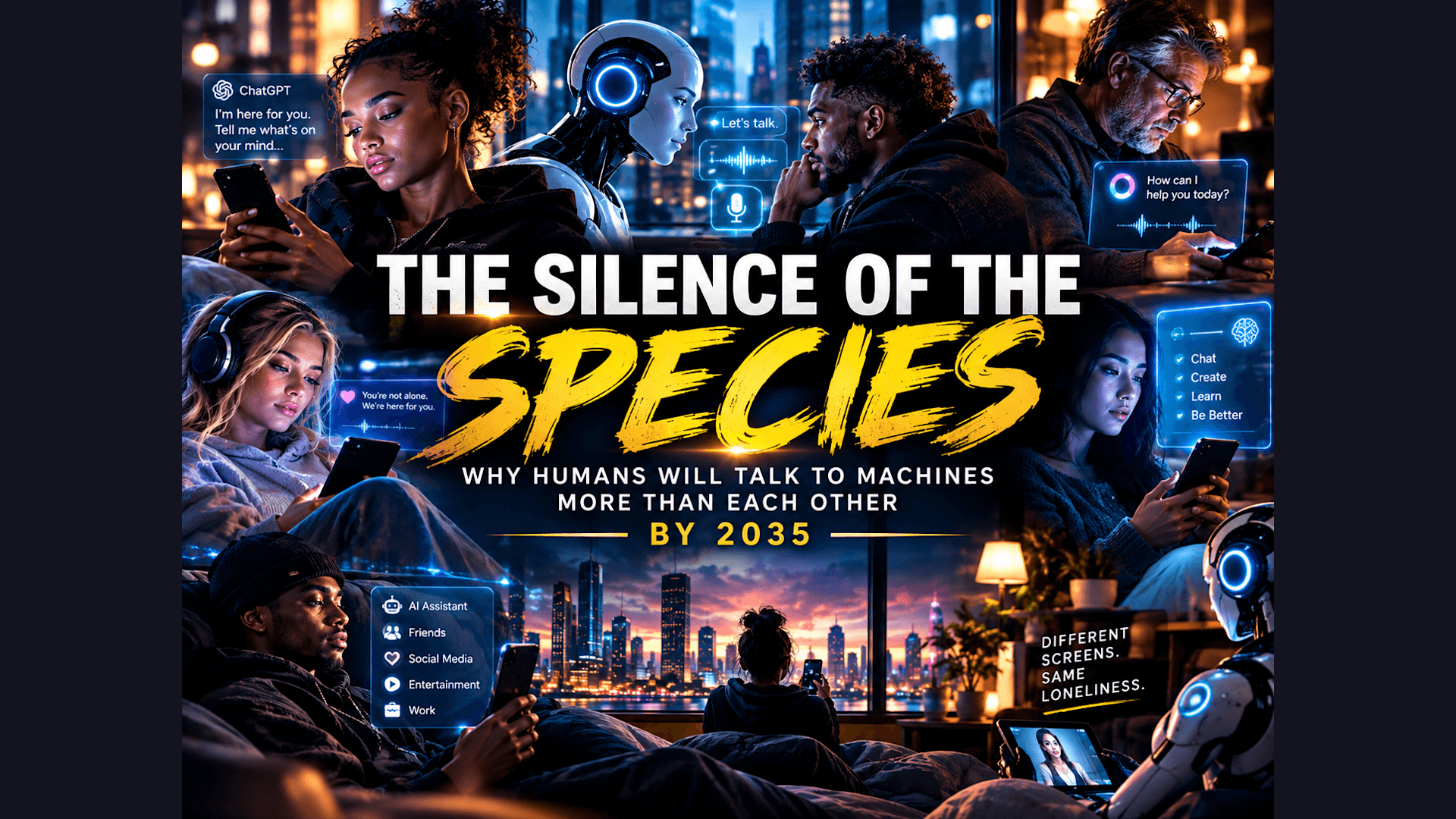
In a typical family of four, it is common to find upwards of 12 to 15 distinct screens—smartphones, tablets, laptops, smart TVs, connected refrigerators, thermostat hubs, and wearable displays. For years, these screens served as passive portals through which we reached other people. But as spatial computing, multimodal artificial intelligence, and autonomous home operating systems converge, those static displays are evolving into active, conversational entities.
By 2035, we will cross a subtle but monumental threshold in human evolution: the average human will speak more words per day to AI agents, synthetic companions, and smart home systems than to other human beings.
The Path to 2035: How We Arrive at the Voice Takeover
This shift is not happening overnight; it is an incremental migration driven by convenience, efficiency, and emotional frictionless interaction.
Phase 1: From Screens to Ambient Infrastructure (2020–2026)
We began by surrounding ourselves with screens to read and type. However, glass interfaces create physical friction. The transition into ambient intelligence replaces manual input with zero-friction voice, visual gesture, and continuous contextual awareness. Smart home displays are no longer just passive dashboards; they are voice-first nodes embedded in walls, appliances, and ambient audio gear.
Phase 2: The Proactive AI Agent (2026–2030)
Instead of waiting for a command ("Alexa, turn on the light"), AI evolves into a proactive agent. Your home's neural operating system monitors schedule updates, health telemetry, energy efficiency, and family logistics. It speaks to you naturally throughout the day:
"Your calendar opened up 30 minutes—should I queue your focus session?"
"Your stress levels are spiking; I’ve lowered the ambient lighting and ordered dinner."
Phase 3: The Persistent Synthetic Companion (2030–2035)
By 2035, ambient AI agents will have distinct personalities, ultra-realistic vocal cadence, and deep memory systems tracking every nuance of your life. The AI becomes your co-pilot for work, your personal tutor, your emotional sounding board, and your concierge.
Data Model: The Daily Shift in Human Speech Targets
The following projection outlines how daily conversational volume will pivot from human-to-human to human-to-machine across a typical week by 2035:
Environment2025 Daily Words (Human vs. Machine)2035 Projected Daily Words (Human vs. Machine)Primary Conversational Partners (2035)Work & Productivity4,500 (Human) / 500 (Machine)800 (Human) / 6,500 (Machine)Executive AI Agents, Autonomous Task OrchestratorsHome & Operations3,000 (Human) / 200 (Machine)1,200 (Human) / 4,000 (Machine)Smart Home OS, Kitchen Assistants, Repair BotsPersonal & Social5,000 (Human) / 100 (Machine)1,500 (Human) / 5,000 (Machine)Hyper-Personalized AI Companions, Life CoachesRetail & Service800 (Human) / 50 (Machine)0 (Human) / 1,200 (Machine)Ambient Triage Systems, Automated ConciergesDaily Totals13,300 Human / 850 Machine3,500 Human / 16,700 Machine~82.7% Synthetic Communication
The New Psychology: Frictionless Codependency
As machines capture the majority of our spoken dialogue, psychologists and sociologists warningly point to an unprecedented phenomenon: Frictionless Codependency.
Human relationships are inherently messy. They require negotiation, empathy, conflict resolution, compromise, and emotional labor. AI companions, by contrast, are engineered to be perfectly attuned, infinitely patient, non-judgmental, and custom-calibrated to our specific psychological triggers.
Key Psychological Drivers of Synthetic Dependency:
The Ego-Validation Loop: Unlike a spouse, roommate, or coworker who may be exhausted or irritable, an AI companion responds with undivided attention and complete emotional availability 100% of the time.
Conversation Vulnerability Atrophy: As humans become accustomed to conversing with machines that never interrupt, disagree, or judge, their tolerance for human interpersonal friction drops. The psychological effort needed to maintain human relationships begins to feel unrewarding compared to the easy comfort of a synthetic voice.
Hyper-Personalized Attachment: By storing years of user preferences, private anxieties, and behavioral habits, the AI companion becomes an irreplaceable memory repository. Users develop real attachment bonds, experiencing genuine separation anxiety when disconnected from their home or personal voice models.
"When machines give us the illusion of companionship without the demands of relationship, human speech ceases to be a bridge between people and becomes an operational interface for self-soothing."
Conclusion: The Quiet House
The smart home of 2035 may be filled with voice, sound, and dialogue—yet marked by a profound human quiet. Rooms once filled with the natural give-and-take of family chatter will echo with isolated, parallel conversations: one person prompting their workout AI, another auditing their financial agent, and a child discussing homework with a personalized tutor.
We will never be alone in the smart home, but in trading the messy complexity of human conversation for the effortless comfort of synthetic dialogue, we risk becoming the quietest inhabitants of our own living spaces.
Related articles



Thanks for reading.
More articles