Article
25 Million Views Later: Waymo Problems x Waymo Famous, Glitches Need Stitches
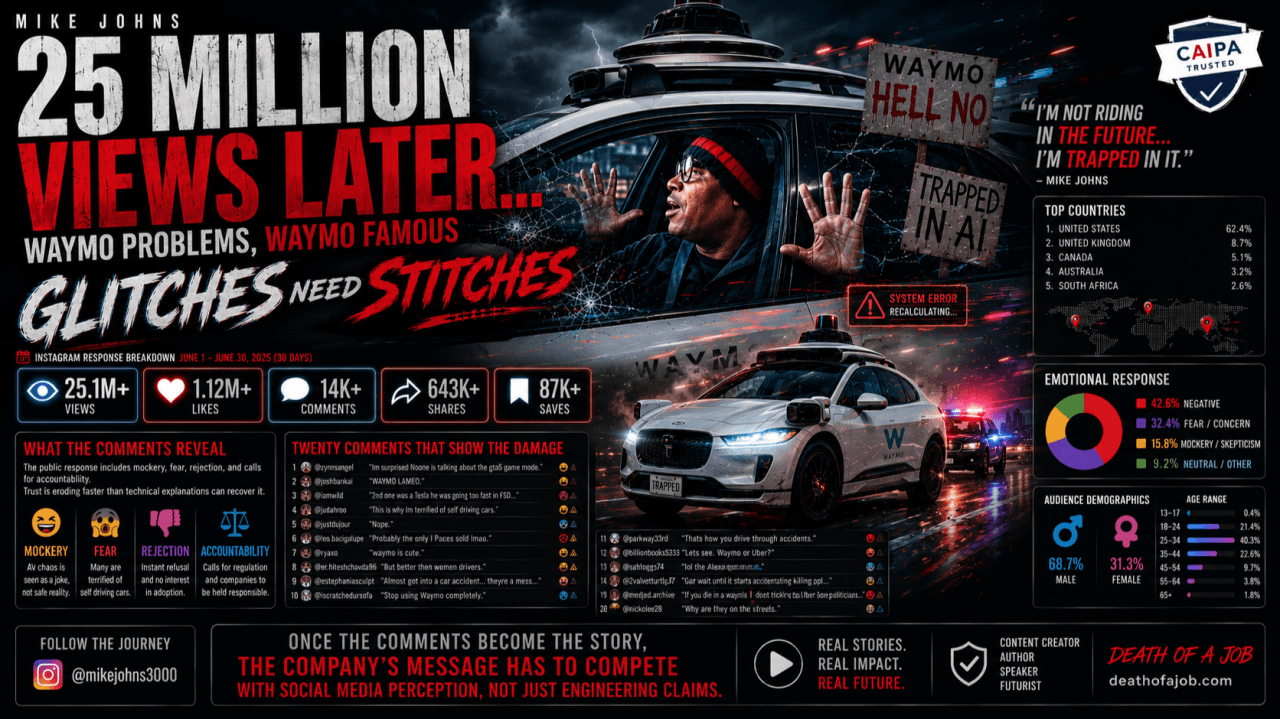
In the last few days, a single reel on my Instagram account—a compilation I titled Waymo Problems…The Saga Continues—has unexpectedly exploded, crossing 25 million views. When I set out to edit these clips, I intentionally paired them with the song "Good Times," a choice meant to add a layer of biting irony to the slew of AV glitches that are essentially crying out for "stitches." I initially hoped it might reach 50,000 views, but it quickly became clear that this combination struck a profound nerve. By using humor as a vehicle to address a serious matter, I found a way to start a conversation that the public is clearly desperate to have: just how safe are these vehicles, really?
The resonance of this video is best captured in one specific, recurring moment I highlighted: a Waymo stopped dead in the middle of the road, blocking traffic and leaving a passenger visibly frustrated. As he repeatedly pleads, “Hey Waymo, please move,” before sarcastically adding, “Alexa,” he perfectly encapsulates the absurdity of the situation. That moment is memorable not just because it is unusual, but because it captures a deeper emotional shift in the public—a transition from passive curiosity to genuine concern. Once a vehicle appears confused, the public no longer separates the individual glitch from the system. They see the brand, the technology, and the failing policy environment all at once.
The fact that this reel has garnered significantly more visibility than the polished, formal reports shared by the industry with the media and the public says something critical: trust is no longer being shaped by white papers, safety dashboards, or curated corporate landing pages. Instead, public perception is being forged through emotionally legible moments that people can understand, share, and judge instantly.
The comment sections confirm this shift; my audience is not processing these incidents as isolated technical hiccups. They are interpreting them as evidence that the technology remains immature, inconsistent, and fundamentally risky.
This massive engagement is a clear, undeniable signal that the public is laser-focused on the widening gap between the polished marketing promise of autonomy and the volatile reality unfolding on our streets. For governors, mayors, and candidates running for office, this is a wake-up call. The technology is moving faster than government policy, and your constituents are already experiencing these risks firsthand. They are watching, they are recording, and they are waiting for leadership that prioritizes public safety over the unchecked acceleration of what feels like a perpetual, real-world beta test.
Fear spreads faster than facts
What the comments reveal is not casual amusement but rising discomfort. The public response includes mockery, fear, rejection, and calls for accountability, which together show that trust is eroding faster than technical explanations can recover it.
See content credentials

MJ3 for CAIPA
Waymo’s Viral Problem Is Bigger Than Waymo
A robotaxi stalling in traffic is not just a glitch. It is a public trust event.
The recent wave of viral content—from the Instagram reels showing Waymos paralyzed in traffic, to my Scottsdale incident where I was trapped in a circling vehicle, covered internationally as a cautionary tale—is doing something that no corporate safety report can undo: it is defining how the public feels about autonomous vehicles in real-time.
And that matters.
When people see a car behave unpredictably, they do not parse the engineering nuance. They react viscerally. They feel frustration, confusion, and genuine fear. Once that threshold is crossed, the conversation shifts from software performance to a fundamental question: Should these systems be on our streets at all?
The Verdict in the Comment Section
The comment sections across these viral clips are not hosting abstract debates. They are filled with disgust, mockery, and anxiety. Comments like “WAYMO LAMEO,” “This is why I’m terrified,” and “Why are they on the streets?” are not just noise—they are the pulse of public sentiment. And public sentiment is the real battleground for AV adoption.
Whether in the U.S. or abroad in France, the conclusion is the same: people do not feel they have control over what is being introduced into their daily lives. In the U.S., the focus is on practical safety and liability; in France, there is a distinct skepticism that Silicon Valley is forcing experimental systems onto society before we have a say in the risks. Different cultures, same conclusion—citizens feel like involuntary participants in a live beta test.
Why the 20-Second Clip Rules the World
Waymo may amass millions of miles and curate exhaustive safety reports, but they are fighting a losing battle against the pulse of the internet. A white paper is a library; a viral video is a wildfire. In our fractured information ecosystem, the era of institutional authority is dead. We have transitioned from a culture of verification to one of visceral reaction. When a 20-second clip surfaces, it doesn't just inform the public; it colonizes their consciousness. A spreadsheet of safety statistics cannot compete with the raw, unfiltered adrenaline of a screen-recorded near-miss.
We are witnessing a seismic shift where corporate transparency has become obsolete. The public has stopped waiting for the "official" version of reality. People are no longer interested in waiting for permission from engineers or bureaucrats to form an opinion—they are drafting their own narrative in real-time, built not on facts, but on the primal power of what they can see and, more dangerously, what they can feel. The report tells us what to think; the viral video tells us what to caution or fear.
The Feedback Loop of Viral "Robotaxi Failures"
The era of institutional authority is dead, incinerated by the visceral, pulse-pounding power of the 20-second clip. While industry giants like Waymo curate sterile white papers and exhaustive safety reports, they are fighting a losing battle against a digital wildfire that colonizes the public consciousness before they can even publish their next update. We have transitioned from a culture of verification to one of primal, unfiltered reaction, where a single screen-recorded near-miss of a "clanking" robotaxi acts as the ultimate truth for a public that no longer cares for bureaucratic permission or engineering nuance. They aren't waiting for the facts; they are drafting their own reality in real-time. But while the masses are whipped into a frenzy by what they feel, I am playing a much more calculated game. By aggressively harvesting and warehousing this chaotic, viral feedback loop from Instagram and LinkedIn, I have transformed this digital wreckage into my own "black gold." In a data-driven world, this viral harvesting of social media comments is the ultimate strategic asset; it captures the raw, unvarnished pulse of human sentiment that telemetry data simply cannot see. These comments are invaluable to the autonomous vehicle industry because they reveal the "human-side" of the edge cases—the psychological friction, the social anxieties, and the specific behaviors that defy engineering logic but define public trust. By decoding the emotional debris of these viral moments, I have gained the ability to shape and mold public opinion, turning the industry’s greatest PR nightmare into a masterclass in behavioral influence.
This Is Why CAIPA Exists
This is why the Consumer AI Protection Advocates (CAIPA) is vital. If autonomous vehicles are to expand, the conversation cannot be limited to innovation and rollout schedules. We need proactive safeguards, clear intervention standards, and a serious examination of the psychological toll these systems take on our communities.
We must answer the hard questions before deployment expands further:
What happens when the system fails in public?
What are the standardized emergency protocols?
Who is truly accountable for the chaos left behind?
How do we rebuild trust after repeated viral failures?
These are not optional inquiries; they are the foundation of responsible innovation. Join us on August 27 for a first-of-its-kind virtual CAIPA event focused on the social, psychological, and policy impact of autonomous vehicles. The future of mobility cannot be built on innovation alone; it must be built on safety, accountability, and an honest dialogue about the reality of our streets.
[Register here]—help us shape a safer path forward, share the invitation, and join the conversation before the next viral incident forces the issue.
As we prepare for the conference, what is the single most important policy change you would want to see policymakers prioritize to begin restoring this fractured public trust?
Related articles



Thanks for reading.
More articles