Article
The Synthetic Engine: How the Peptide Cartel Deleted Burnout and Re-Coded the Future of Work
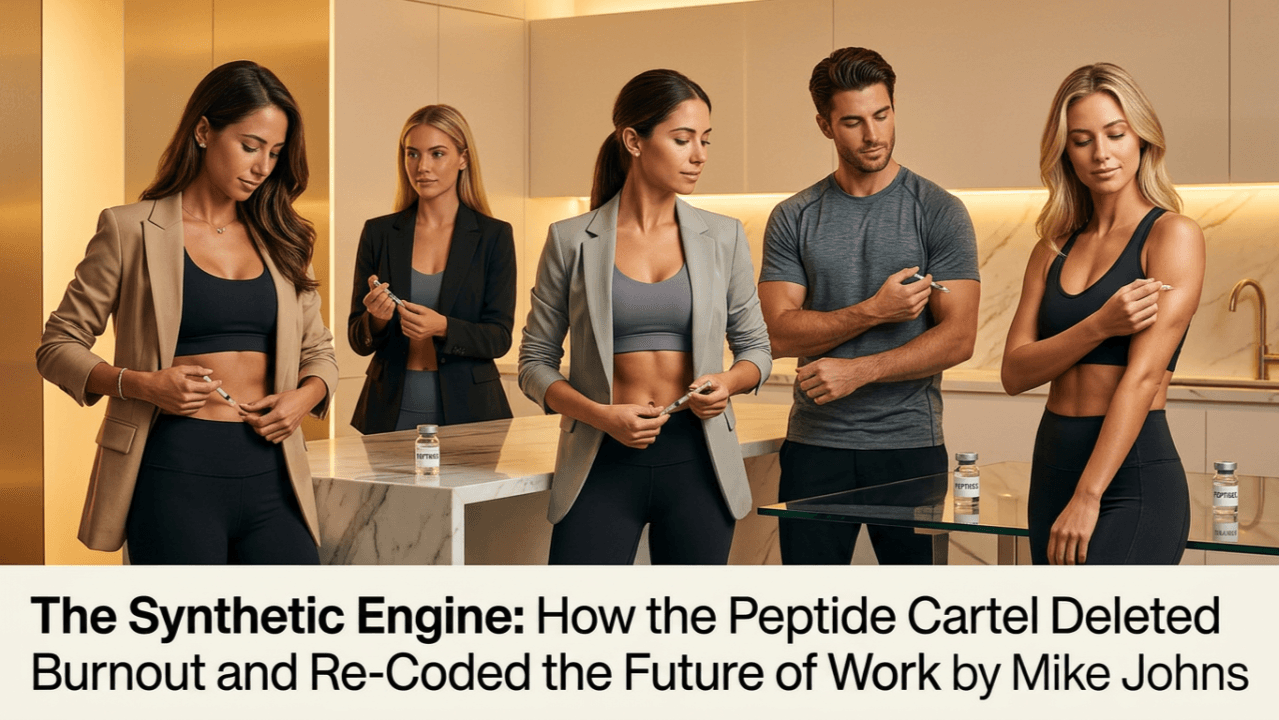
I met Barbie on a flight on the way to Las Vegas. Not the doll—this was a real woman, platinum hair, perfect CES-ready aesthetic, laptop open, phone blowing up, aura screaming “I don’t sleep, I optimize.”
Five minutes into small talk, she wasn’t asking what I do. She was explaining what she injects.
“Have you tried peptides yet?” she asked, casually, like she was offering me a drink. In that moment, cruising at 30,000 feet, I realized something: the tech world has moved on from cannabis gummies and conference cocktails. There is a new molecule in the mix, and it’s not just in gyms—it’s in hacker houses, founder group chats, VC back rooms, and yes, on flights to CES, #wtf.
What Peptides Actually Are
Let’s strip away the hype. A peptide is a short chain of amino acids—the same building blocks that make up proteins. Your body already runs on peptides; insulin, some hormones, and many signaling molecules are peptides. In medicine, peptide-based drugs have been approved for things like type 2 diabetes, obesity, multiple sclerosis, and more.
What’s New is Not the Science: It’s the Culture.
The same compounds (or their cousins) that used to sit in sterile pharma pipelines are now showing up as “peptide therapy,” “anti-aging shots,” “recovery stacks,” “fat-loss drips,” and “Barbie drugs” on TikTok and in wellness clinics. Pills, injections, nasal sprays, topical creams—pick your delivery. This is where tech stepped in.
How the Peptide Cartel is Engineering the Next Human OS
In my world—the tech, AI, and startup ecosystem—peptides slide perfectly into an existing mindset:
Move fast, break things (sounds familiar?).
Ship now, patch later.
Optimization is a lifestyle, not a feature.
For tech workers and founders, peptides check all the boxes:
Productivity: Claims of better sleep, more focus, faster recovery from workouts or burnout.
Aesthetics: Tighter skin, more muscle, less fat—perfect for the personal brand and the keynote stage.
Longevity: The dream of living longer and outputting more, fueled by biohacking podcasts and longevity influencers.
If cannabis was the “chill out after the grind” drug and alcohol was the social lubricant at networking mixers, peptides are something different: the “hack your meat suit so you can grind harder” drug.
They sit in that 'gray zone'—more hardcore than supplements, not quite as regulated (in practice) as traditional prescription meds. That in-between status is exactly what makes them attractive to tech people who already live in beta versions of the future.
From Cannabis and Cocktails to Code and Needles
Let’s be honest about the arc:
Phase 1: Alcohol as culture – conference open bars, industry parties, “let’s grab drinks and talk deal flow.”
Phase 2: Cannabis as culture – gummies and vapes for creativity, anxiety, and “wellness.”
Phase 3: Smart drugs / nootropics – modafinil, racetams, stacks in unmarked bottles, “limitless” fantasies.
Phase 4: GLP‑1s & weight-loss injectables – Ozempic, Wegovy, Mounjaro; society suddenly okay with needles if they equal thin.
Phase 5: Peptides – targeted micro-adjustments: sleep, skin, libido, recovery, fat loss, energy, “performance.”
Peptides are the natural next step in the stack. They are not about escaping reality. They’re about editing reality—your own biology—so you can compete in a market where it feels like everyone is running on overclocked hardware.

Artwork Generated By Mike Johns
Fresh in From China, Supply Chains, and the 'Gray Market'
Whenever you see a hot chemical trend in America, you’re usually seeing the front end of a global supply chain. Peptides are no different.
A huge amount of the raw peptide powder and finished vials circulating in the U.S. comes from Chinese manufacturing labs. Some are legitimate producers that also supply pharma; others live in a gray zone, marketing “research chemicals not for human use” while knowing exactly what’s happening on the other end.
Why China is So Key:
Massive, flexible chemical manufacturing capacity.
Lower cost of production, making exotic peptides accessible to regular people, not just elite clinics.
Loose or patchwork enforcement, allowing “research only” products to flow into online sellers, biohacker Telegram channels, and burner websites.
The result: in America, we now have a parallel peptide economy. On one side, regulated medical use in clinics and hospitals. On the other, a semi‑underground scene of imported vials, self‑injection tutorials, and “peptide raves” where people compare stacks the way we used to compare sneakers.
Why Some Women Are In: The “Barbie Drug” Era
The woman on the plane—Barbie—wasn’t talking about deadlifting PRs. She was talking about skin, energy, and body composition.
Peptides are trending hard with women because they promise:
Youthful skin without going fully under the knife.
“Lean and toned” without living in the gym.
Better sleep, mood, and libido, all wrapped in a “wellness” and “hormone balance” narrative.
There’s a disturbing marketing layer here: Some tanning and appetite‑suppressing peptides (like certain “Barbie” or “tanning” shots) are pushed aggressively to women who are already under brutal pressure to look ageless, small, and camera-ready at all times.
So you get a culture where:
Injecting something experimental is framed as “self-care.”
Complexity is hidden behind soft branding: pink syringes, cute packaging, girlboss copy.
Side effects and unknown long-term risks get buried under transformation photos and “my coach said it’s safe.”
It’s the same old body politics, just plugged into a more advanced chemistry set.
Why Men Are In: Muscle, Money, and Male Anxiety
For men, the marketing script is different:
More muscle, less fat.
Faster recovery.
Higher testosterone, better libido, more “alpha energy.”
In a tech culture where:
Founders are competing not just on code but on aura.
Aging male execs are surrounded by 23-year-olds who sleep on the floor and ship product at 3 a.m.
Status is visual—watches, bodies, jawlines, performance scores.
Peptides become a way to quiet the fear of becoming obsolete—physically and professionally. It’s not just vanity; it’s job security theater. If you look optimized, maybe no one will question whether you are.
The Risks No One Wants to Put in the Group Chat
Let’s be clear: there is a huge difference between:
FDA‑approved peptide medications used under medical supervision for specific conditions, and
Unregulated blends bought online, compounded inconsistently, dosed by vibes and Reddit anecdotes.
The problems:
Impurities or mislabeling in gray-market products.
No long-term safety data for some exotic peptides being casually injected.
People stacking multiple compounds without any understanding of interactions.
Social pressure in tech circles where “everyone is on something,” so you feel behind if you’re not.
If performance is the new religion, peptides are becoming the sacrament—taken on faith, blessed by podcasts, justified by “n=1” anecdotes, and rarely questioned until something goes wrong.
What’s Coming Next
If peptides are today’s wave, the next waves are already forming:
More targeted “bioregulators” to switch on/off specific cellular processes.
AI‑designed molecules that optimize binding to receptors while minimizing known side effects.
Fully integrated stacks: your wearables feed health data into an app that auto-adjusts your dose.
Corporate normalization: companies quietly subsidizing “performance health” the way they once rolled out free snacks and gym memberships.
In other words, we’re heading toward a world where pharmacology becomes part of the job description, especially in high‑pressure, high‑status sectors like tech.
Why This Matters (And Why I’m Talking About It)
Sitting on that flight, listening to Barbie explain her peptide stack, I had two simultaneous reactions:
The futurist in me thought: “Of course. This is where human‑machine culture was always going. We optimized the devices; now we optimize the operators.”
The human in me thought: “Damn, we really don’t believe our natural selves are enough anymore.”
This matters because:
It exposes how deeply capitalism has colonized our bodies—our sleep, skin, hormones, weight, mood are now “optimization problems” to be solved with injections.
It accelerates inequality—those who can afford cutting‑edge chemistry will literally embody an advantage.
It shifts the Overton window—what once seemed extreme (injecting experimental substances to work harder) becomes normal in elite circles, then aspirational for everyone else.
I’m not here to tell you peptides are all good or all bad. I’m here to say: when tech people start using drugs not to escape reality, but to out‑compete you in it, that’s a different level of game.
Somewhere between cannabis and code, we entered a new era: Your body is now a startup. Your bloodstream is now a platform. And the question isn’t “Are peptides safe?” so much as “What does it mean when the default human model is no longer considered adequate for participation in the future of work?”
On that flight to Vegas, Barbie didn’t just introduce me to a drug. She introduced me to a mirror. And in that reflection, I saw a culture that will do anything—inject anything—to avoid feeling average in a world that worships the optimized. End game, I’m a watcher until this is regulated I just observe others.
Related articles

Thanks for reading.
More articles