Article
A Tale of Two Cities: Why NYC & LA Ban AI in School
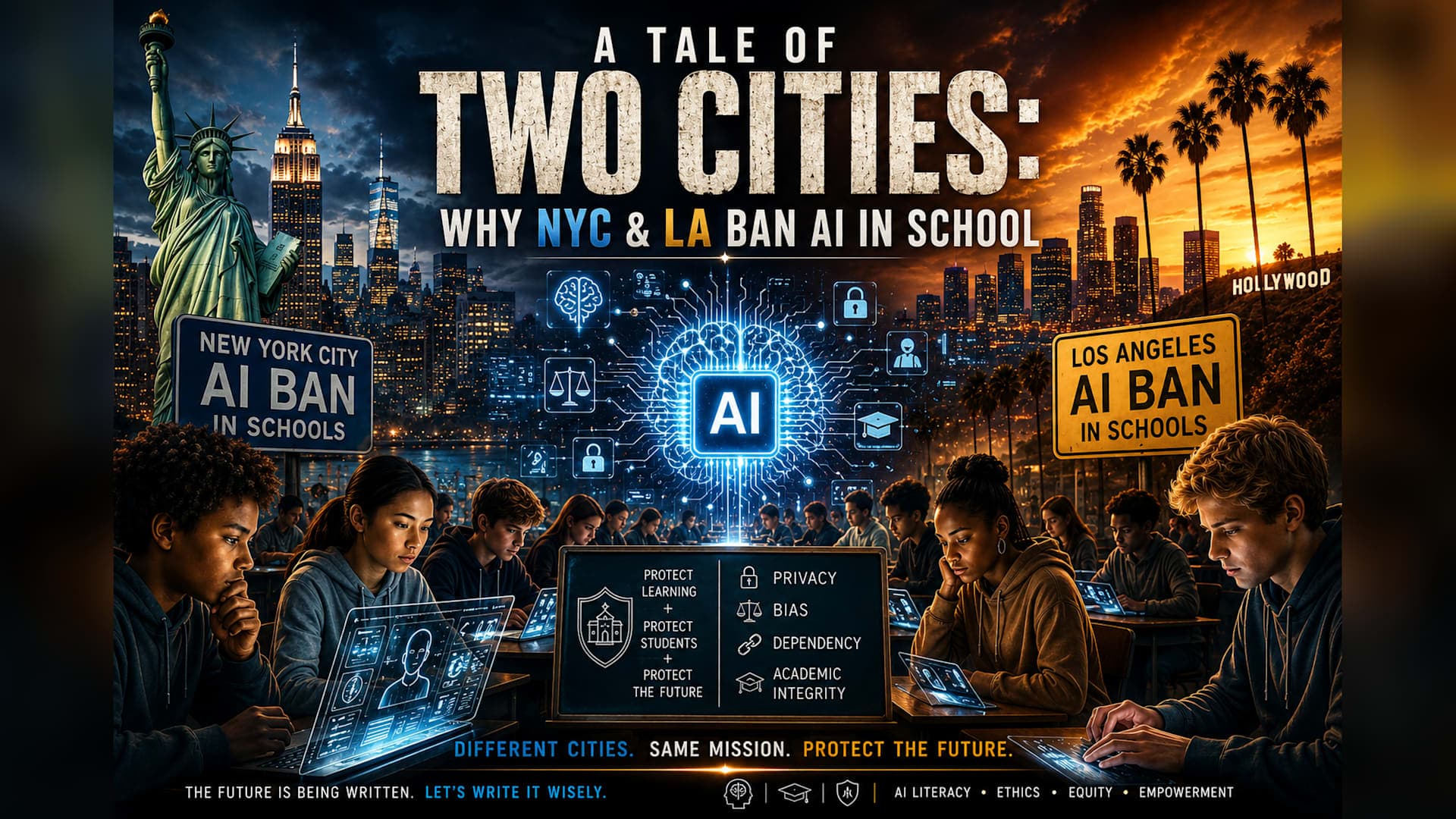
The surface headline sounds like a knee-jerk reaction: Districts ban AI. But look closer. Beneath the policy jargon lies a far more profound—and urgent—reckoning. This isn't just a feud over cheating, chatbots, or homework. It’s a battle over the fundamental architecture of human intelligence. What do children actually need to learn before an algorithm starts thinking for them?
The Two-City Shift
New York City has barred student-facing generative AI tools—including prompt-driven tutors and conversational bots—across all preschool through eighth-grade classrooms. High schools may get limited exceptions, establishing a clear thesis: age, brain development, and pedagogical intent must dictate technology's boundaries. Unsurprisingly, this restriction lands alongside a sweeping push to reduce total screen time for younger students.
Los Angeles, meanwhile, hit an even harder pause. LAUSD enacted a blanket moratorium on student AI use across all district-owned devices, featuring no expiration date. Top academic officers rendered the tech inaccessible to all students "until further notice."
Yet, there’s a vital twist: teachers in both districts are still free to use AI.
This distinction is revealing. These megadistricts aren’t necessarily waging an anti-tech holy war. They are rejecting the dogma that schools must blindly rush toward integration before understanding what these machines do to a child’s attention span, privacy, and capacity for original thought.
The Struggle Before the Shortcut
For years, the dominant tech-in-ed mantra was simple: Adapt or get left behind.
It’s a compelling argument. Students will inevitably collide with AI in college, modern workplaces, online ecosystems, and daily life. Pretending the technology doesn't exist is a head-in-the-sand strategy. But NYC and LA are posing the crucial question that tech evangelists conveniently skip:
What must a child master independently before AI becomes an assistant, rather than a surrogate for curiosity, judgment, and struggle?
A calculator accelerates math, but a child still needs number sense. Spellcheck fixes a typo, but it cannot forge a writer’s distinct voice. Generative AI can manufacture a five-paragraph essay in four seconds, but it cannot guarantee the student formed an argument, wrestled with evidence, or experienced the electric, difficult triumph of putting an original thought into words.
When AI arrives too early, learning devolves into mere answer collection. But schools do not exist to train children to collect answers. They exist to teach them how to ask better questions.
The Screen-Time Reckoning
Generative AI isn't sitting in a vacuum; it’s crashing directly into a growing pushback against screen saturation.
LAUSD’s AI moratorium was birthed alongside a strict mandate targeting overall screen exposure—eliminating screen time entirely for kids through first grade, then scaling up incrementally. For a decade, the unquestioned dogma was that more tech equaled more progress: more apps, more devices, more dashboards. Now, parents and policymakers are confronting the hidden receipts:
Fractured Attention: Deep reading traded for frantic skimming.
Passive Reliance: Muscle memory built on black-box platforms students don't understand.
Atrophied Basics: Deteriorating handwriting, physical research habits, and raw problem-solving patience.
The Interactivity Trap: Unlike a static textbook or a Chromebook, generative AI talks back. It flatters, imitates authority, mimics empathy, and delivers persuasive work far more articulate than the kid prompting it.
The Great Classroom Contradiction
There is an unavoidable irony running through the LA policy. Prior to the moratorium, the district had actively rolled out AI to older students following "digital literacy" modules. In fact, board members expressed shock to learn a district-wide student ban was already operational under their noses.
That friction exposes a chaotic reality: America is trying to draft policy for a technology that mutates faster than school board calendars.
School leaders are being forced to referee a game where no one can even agree on what the ball is:
Is AI a transformative study partner, or a systemic threat to academic integrity?
Is it a crucial accessibility aid, or just a new layer of screen addiction?
Is it essential workforce prep, or a massive data-harvesting liability?
The uncomfortable truth? It’s all of them at once.
A Ban Is a Pause, Not a Plan
A moratorium buys time, but a ban is not a strategy.
If students are ultimately destined to inhabit an AI-driven economy, public education must eventually define what responsible reentry looks like. A real AI-literacy framework wouldn't just be a list of "don'ts." It would train students to:
Identify Synthetic Accuracy: Spotting answers that sound brilliantly confident, yet are flatly wrong.
Trace Primary Sources: Demanding real-world evidence behind algorithmic claims.
Demand Transparency: Learning to disclose exactly how and where a machine influenced their work.
Protect Sovereignty: Guarding personal data and refusing to let a model outsource their own critical reasoning.
The core question facing educators isn't AI vs. No AI. It’s deciding which learning must remain fiercely, uncompromisingly human.
The Uncomfortable Question Left Behind
New York and Los Angeles may be the first dominoes in a national retreat from hyper-digitized classrooms. But their bold move leaves us with an alarming dilemma.
If affluent families can afford private tutors, elite academies, paid AI models, and tech-literate parents to guide them, while public schools ban or delay access—who gets to shape the future AI economy, and who is merely subjected to it?
Conversely, if public schools rush young minds into the arms of generative algorithms without cognitive safeguards, who will be left with the ability to think when there isn't a machine around to finish the sentence?
That is the true tale of these two cities. They aren't just deciding whether kids can use chatbots for homework. They are deciding what childhood, education, and human intelligence are supposed to mean.
Related articles

Thanks for reading.
More articles