Article
AI Is Already Working in America. The Real Question Is Whether America Is Preparing Its People.
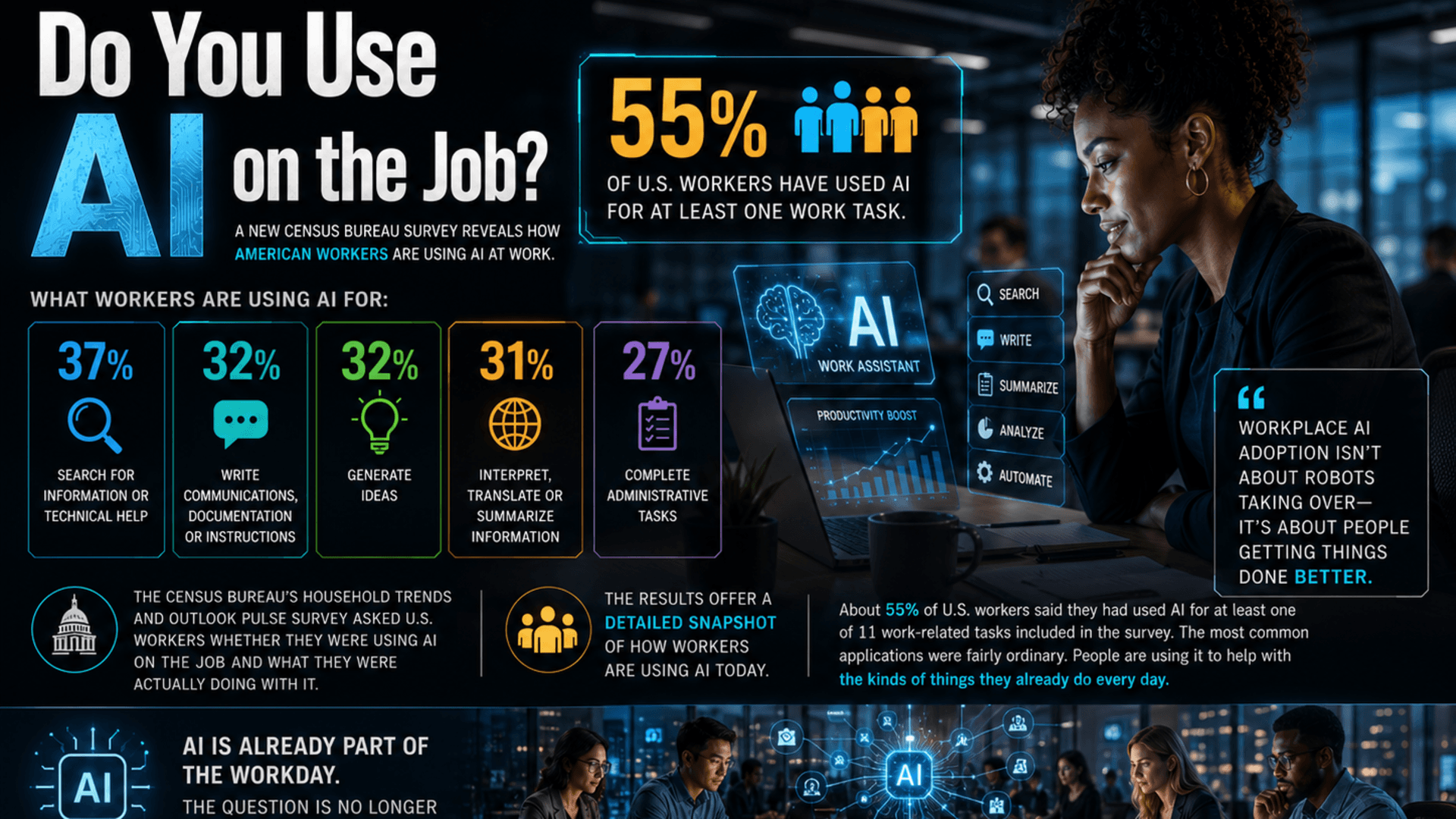
Artificial intelligence is no longer a future-of-work conversation. It is already part of the American workday.
New U.S. Census Bureau data shows that 55% of U.S. workers have used AI for at least one workplace task. Not in some distant, fully automated future—but now, in the ordinary flow of work: finding information, drafting communications, generating ideas, summarizing documents, translating content, and completing administrative tasks.
That statistic should change the conversation. The question is no longer, “Will AI affect jobs?” The better question is: Who is being equipped to use AI well, who is being left behind, and what are employers, schools, cities, and government doing about it?
AI Has Entered Everyday Work
The Census Bureau’s March 2026 Household Trends and Outlook Pulse Survey gives us one of the clearest snapshots yet of how AI is showing up across the workforce.
Workers reported using AI most often for practical, immediate tasks:
Workplace useShare of U.S. workers reporting use
Searching for information or technical help 37%
Writing communications, documentation, or instructions 32%
Generating ideas 32%
Interpreting, translating, or summarizing information 31%
Administrative tasks 27%
This matters because it proves that AI adoption is not limited to programmers, data scientists, or major technology companies. The frontline worker, small-business owner, educator, government employee, customer-service representative, marketer, creator, and entrepreneur are all beginning to use AI as a practical work assistant.
AI is becoming a new layer of workplace literacy—similar to email, search engines, spreadsheets, and smartphones before it.
The Productivity Opportunity Is Real
For many workers, AI is not replacing their job. It is removing friction from the job.
Among people who used AI at work in the prior week, 31% said it saved them one to two hours on their work. Another 15% said it saved three to four hours, and an additional 15% reported savings of more than four hours. A quarter reported saving less than an hour.
Those hours matter.
One or two recovered hours can mean more time to serve a customer, coach a student, develop a new idea, prepare for a meeting, follow up with a client, or simply focus on the part of the work that requires human judgment. At scale, small improvements to everyday tasks can create major gains for organizations and local economies.
But we should be honest: the benefit is not automatic. Ten percent of respondents said AI saved them no time, while 3% said it actually added time. That is the reminder America needs. Access to a tool is not the same as knowing how to use it productively, responsibly, or safely.
AI Literacy Is Now Workforce Infrastructure
The biggest AI gap may not be between people who have jobs and people who do not. It may be between people who know how to work with AI and people who are never given the training, tools, time, or confidence to learn.
A worker who understands how to ask better questions, verify AI-generated answers, protect sensitive information, recognize bias, and apply a tool to a real task can create more value. A worker who has never received that education may see AI only as a threat rather than as a capability they can build.
That is why AI literacy must move beyond executive boardrooms and computer-science departments. It belongs in:
High schools, community colleges, and workforce-development programs.
Small-business support and entrepreneurship programs.
Government agencies and public-service organizations.
Union, athlete, creator, and community networks.
Employer training programs that reach every level of the organization.
Louisville Metro Government offers an important example. Rather than expecting a central AI office to identify every use case, its leaders are training interested employees, encouraging them to identify opportunities inside their own departments, and pairing experimentation with cybersecurity guardrails and support.
That is the model: empower the people closest to the work, but do not leave them alone with the technology.
America Must Build Human-Centered Adoption
America’s AI future cannot be defined only by data centers, chips, billion-dollar valuations, or which company releases the next model. Those investments matter, but the true test is whether everyday people can use AI to expand opportunity.
We need organizations to establish clear rules for privacy, security, accuracy, intellectual property, and human accountability. We need employers to measure whether AI is actually improving work rather than merely adding another dashboard or mandate. And we need public leaders to make sure access reaches communities that have historically been excluded from technological transformation.
The Census Bureau is doing something valuable by measuring what workers are actually experiencing. Its data shows that AI is already on the job, with nearly one-quarter of AI-using workers reporting daily use in the previous week and another 46% reporting use on at least one day.
The transformation has already begun.
Now America must decide whether AI will become another divide—or a tool that helps more people become more capable, creative, productive, and prepared for the future of work.
Related articles



Thanks for reading.
More articles