Article
America’s AI Ultimatum: Choose Washington—or Risk Being Locked Out of the Future
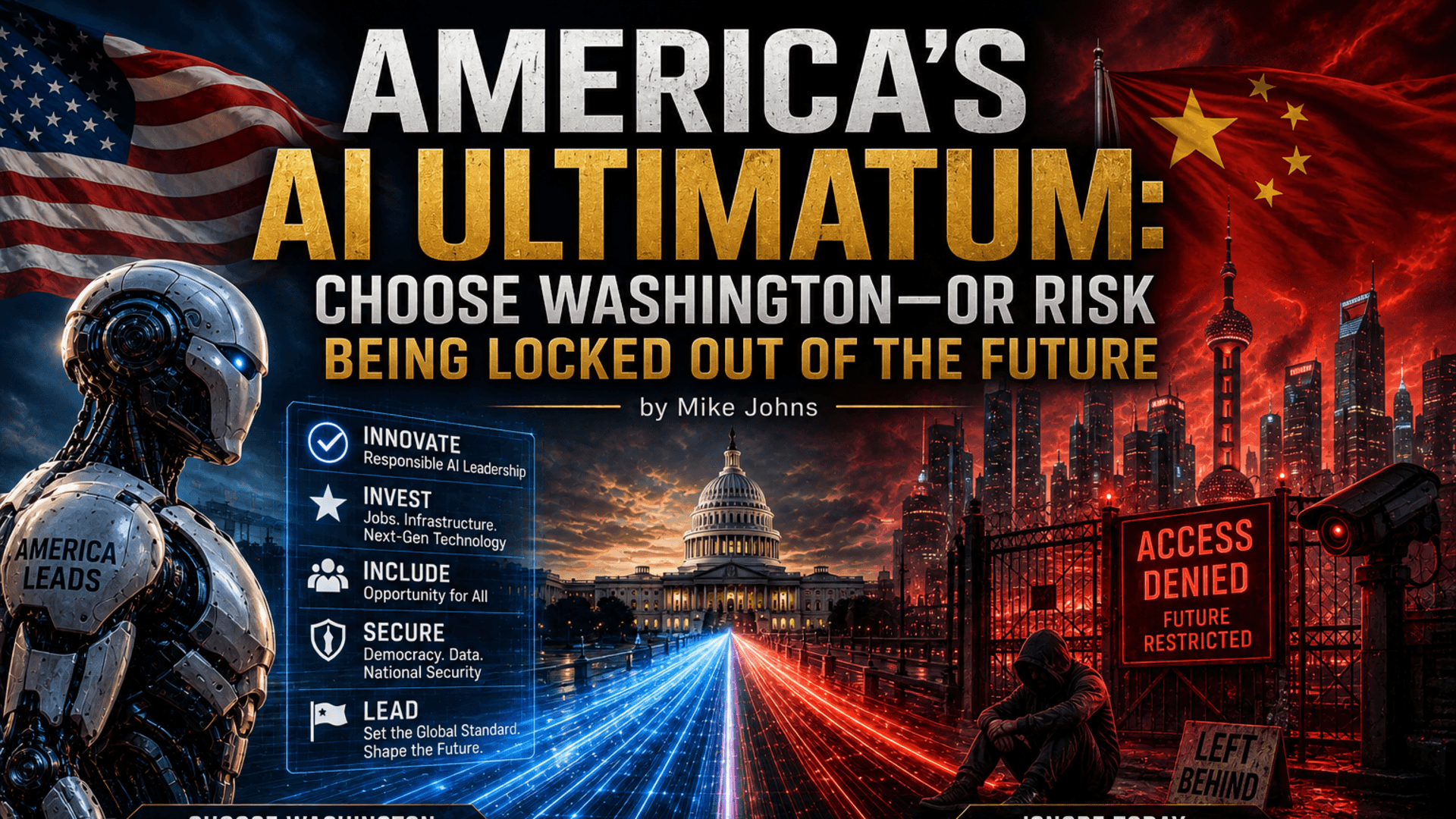
The global AI race is no longer just about who builds the smartest model, manufactures the fastest chip, or attracts the best researchers. It is rapidly becoming a geopolitical loyalty test.
According to Reuters, the U.S. State Department has drafted a letter that would press 35 countries aligned with an American AI cooperation statement to choose between a U.S.-led technology ecosystem and competing initiatives linked to China. The message is direct: countries that attempt to participate in both may risk exclusion from Washington’s AI coalition.
This is not ordinary technology diplomacy. It is the formation of AI blocs—and the decisions made now could determine who controls the infrastructure, minerals, data standards, supply chains, jobs, and economic upside of the next industrial era.
The AI Cold War Is Becoming Real
The U.S. has built Pax Silica around securing AI-related supply chains: advanced models, semiconductors, and critical minerals. Roughly two dozen countries have joined, including Japan, Australia, South Korea, and Kazakhstan. The broader U.S. “AI Opportunity Statement” reportedly has 35 signatories.
China, meanwhile, launched the World Artificial Intelligence Cooperation Organization in July, with President Xi Jinping promoting China’s open-weight AI technologies as an alternative to American influence.
That creates a hard reality for nations across Africa, Latin America, the Middle East, Central Asia, Southeast Asia, and Europe: they may increasingly be asked to choose a technological operating system for their future.
The draft language reviewed by Reuters captures Washington’s posture: “To be part of everything is to be part of nothing.” It calls participation in Pax Silica not merely membership, but a commitment that cannot coexist with “duplicative initiatives” that have conflicting expectations.
Why Kazakhstan Matters
Kazakhstan has emerged as a critical case study because it is reportedly the only country known to have joined both the U.S.-associated Pax Silica initiative and China’s competing framework. That puts the country—and its reserves of critical minerals—at the center of the strategic contest.
This is a reminder that AI is not just software.
Every advanced AI system depends on physical infrastructure: chips, data centers, electricity, networking equipment, cooling systems, rare earth elements, and minerals that power modern technology. Countries with access to those resources are no longer simply suppliers. They are strategic players in the AI economy.
The battle for AI leadership may be marketed as a battle over algorithms, but beneath it is a struggle over mines, manufacturing capacity, energy, and influence.
Open Models Are Reshaping Power
For years, many people assumed America’s advantage in frontier AI would be almost impossible to challenge. That assumption is being tested.
Reuters reports that Chinese open-weight models have made rapid gains relative to proprietary systems developed by U.S. companies such as OpenAI and Anthropic. At the same time, Beijing is considering limits on overseas access to some leading Chinese AI models, reflecting the increasing national-security stakes around advanced AI capabilities.
Open-weight AI changes the global equation because it can be adopted, customized, and deployed by countries and organizations that do not want to depend entirely on a handful of U.S. technology companies. For governments seeking lower-cost access, greater technical independence, or local control over data, open models may be especially appealing.
But openness does not eliminate risk. It also raises real questions about misuse, cybersecurity, model security, misinformation, autonomous hacking, and the ability of governments to manage highly capable systems once they spread.
The Risk of a Divided AI World
A divided AI world may create stronger national-security boundaries, but it could also make innovation more fragmented and less trustworthy.
If countries are forced into separate AI ecosystems, we could see competing standards for safety, data privacy, cybersecurity, chips, cloud infrastructure, digital identity, and autonomous systems. Businesses could face higher compliance costs. Researchers could lose access to global collaboration. Smaller nations could lose the ability to negotiate from a position of flexibility.
The danger is that AI becomes not a tool for broad human progress, but a gatekept asset controlled by a small number of geopolitical power centers.
For educators, workforce leaders, entrepreneurs, and communities, this rivalry has practical consequences. The AI tools available in a school, small business, government agency, or job-training program may increasingly depend on the alliances their country chooses.
The Stakes Are Bigger Than Technology
The U.S. has a legitimate interest in protecting advanced technology, critical infrastructure, supply chains, and national security. China also has a clear interest in reducing its dependence on foreign technology and expanding its influence through its own AI ecosystem.
But the world should be cautious about treating AI cooperation as a zero-sum loyalty contest.
The best outcome is not a future where nations are forced to choose one technological superpower forever. It is a future where countries can protect security interests while still collaborating on safety, workforce development, interoperability, scientific research, and responsible innovation.
AI will shape how people work, learn, communicate, access health care, build businesses, and participate in society. That is too consequential to be governed only by strategic competition.
The AI race is now a contest for global influence. But the question leaders should ask is larger than who wins: Will the AI future be built around shared human progress—or around permanent technological division?
Related articles



Thanks for reading.
More articles