Article
Atlanta Tech Week Ignites a Critical AI Conversation: Death of a Job Challenges Atlanta to Get Skilled Before It’s Too Late
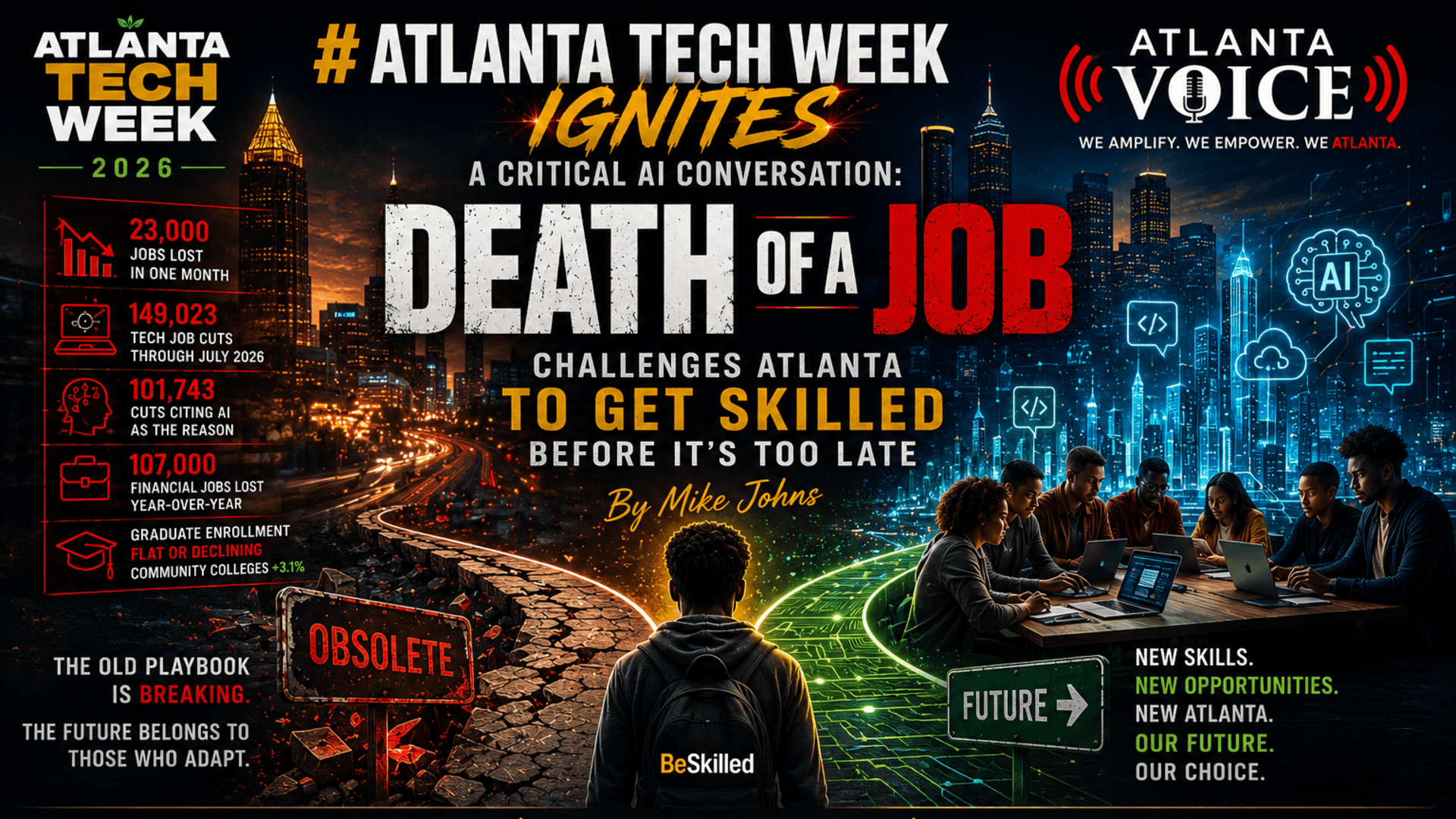
Atlanta Tech Week brought energy, urgency, and a packed room to The Atlanta Voice for an unforgettable edition of Death of a Job: BeSkilled or Be Replaced—a timely conversation about artificial intelligence, job disruption, family stability, and the skills people need to remain relevant in the new economy.
With a DJ setting the tone, a bartender serving guests, and a live audience filled with entrepreneurs, corporate leaders, educators, students, professionals, and community advocates, the evening felt like more than a tech event. It felt like a movement.
Moderated by Oneshia Freeman Rojales, MBA, Georgia Technology Authority, the 90-minute fireside chat featured futurist, author, and technology strategist Mike Johns. The dialogue went straight to the questions facing workers and families across Atlanta and the nation: What happens when AI changes the work we do? Who is prepared? Who gets left behind? And what can people do now to protect and advance their futures?
The room was ready
The event drew a standing-room-only crowd during Atlanta Tech Week, demonstrating a growing hunger for honest, accessible conversations about AI and the future of work.
Attendees did not come simply to hear about new technology. They came looking for answers. They wanted to understand how AI could affect their careers, businesses, children, communities, and long-term economic security.
“People are not just worried about AI taking jobs—they are asking how to stay valuable in a world where the definition of work is changing,” Johns said. “The answer is not panic. The answer is preparation, skills, adaptability, and access.”
Throughout the evening, Freeman Rojales challenged Johns with direct questions about the social and economic consequences of automation. She explored what AI means for parents, young professionals, mid-career workers, entrepreneurs, and organizations trying to balance innovation with responsibility.
“This conversation has to be human-centered,” Freeman Rojales said. “AI may be the technology, but people, families, and communities will feel the impact. We have to make sure they are prepared to participate in the opportunity.”
AI is personal
One of the strongest messages of the night was that AI is no longer a distant concept reserved for technology companies. It is already influencing how people write, create, sell, hire, learn, communicate, manage customer service, and make business decisions.
Johns emphasized that workers do not need to become software engineers to thrive in an AI-powered economy. But they do need AI literacy—the ability to understand, evaluate, and use AI tools in responsible and productive ways.
“AI literacy is becoming a basic workforce skill,” Johns said. “The people who learn to work with these tools will have more options than the people who ignore them.”
The conversation also focused on the skills technology cannot easily replace: critical thinking, leadership, creativity, emotional intelligence, communication, cultural awareness, and trusted relationships.
For many in the audience, that message landed deeply.
“This was a wake-up call,” said one attendee. “It made me think about my own career, but it also made me think about what my children need to learn now.”
Corporate voices add perspective
Diane Angibeau, Fire Solution Executive for AT&T Business, was among the leaders who added an important business perspective to the event’s central message.
“The future of work requires more than technology adoption,” Angibeau said. “It requires intentional investment in people, training, and access. When organizations prepare their workforce, innovation becomes an opportunity instead of a threat.”
Her comments reinforced the need for employers, educators, policymakers, and community leaders to work together. As companies bring AI into more aspects of operations, workforce development cannot be an afterthought.
“The most important takeaway was that everyone has a role to play,” another attendee said. “Businesses need to train people. Schools need to prepare people. And individuals have to take ownership of their own learning.”
What you missed
Those who missed the event missed a high-energy, honest discussion that went beyond headlines and fear.
They missed a room of Atlantans asking the questions many Americans are quietly carrying:
Is my job at risk—or can AI help me grow?
How can I use AI without being replaced by it?
What should parents teach their children about the future of work?
How can small businesses compete in an AI-driven economy?
What skills will create opportunity over the next decade?
How do communities make sure AI does not widen existing economic gaps?
They also missed a message of empowerment: the future is not predetermined.
The people, companies, and cities that invest in skills, access, education, and responsible innovation will be best positioned to lead. Atlanta has the talent, culture, institutions, and entrepreneurial drive to be one of those cities.
The conversation continues
The packed house, live stream, and continued discussion after the program made one thing clear: people are eager to learn.
Death of a Job: Future of Work will continue this fall with additional conversations, workshops, and community-focused programming designed to help people understand AI, build practical skills, and navigate the changing world of work.
“We cannot wait until a job disappears to start preparing people for what comes next,” Johns said. “Reskilling has to become part of how we work, how we educate, and how we build stronger communities.”
The Atlanta Tech Week gathering at The Atlanta Voice was a reminder that the AI era is already here. The only question is whether we will meet it with fear—or with the skills, vision, and determination to shape what comes next.
To purchase Death of a Job: BeSkilled or Be Replaced by Mike Johns, visit DeathofaJob.com.
Related articles



Thanks for reading.
More articles