Article
Barbie vs. Ken on Smartphones: What the Data Reveals About Gender and Digital Life
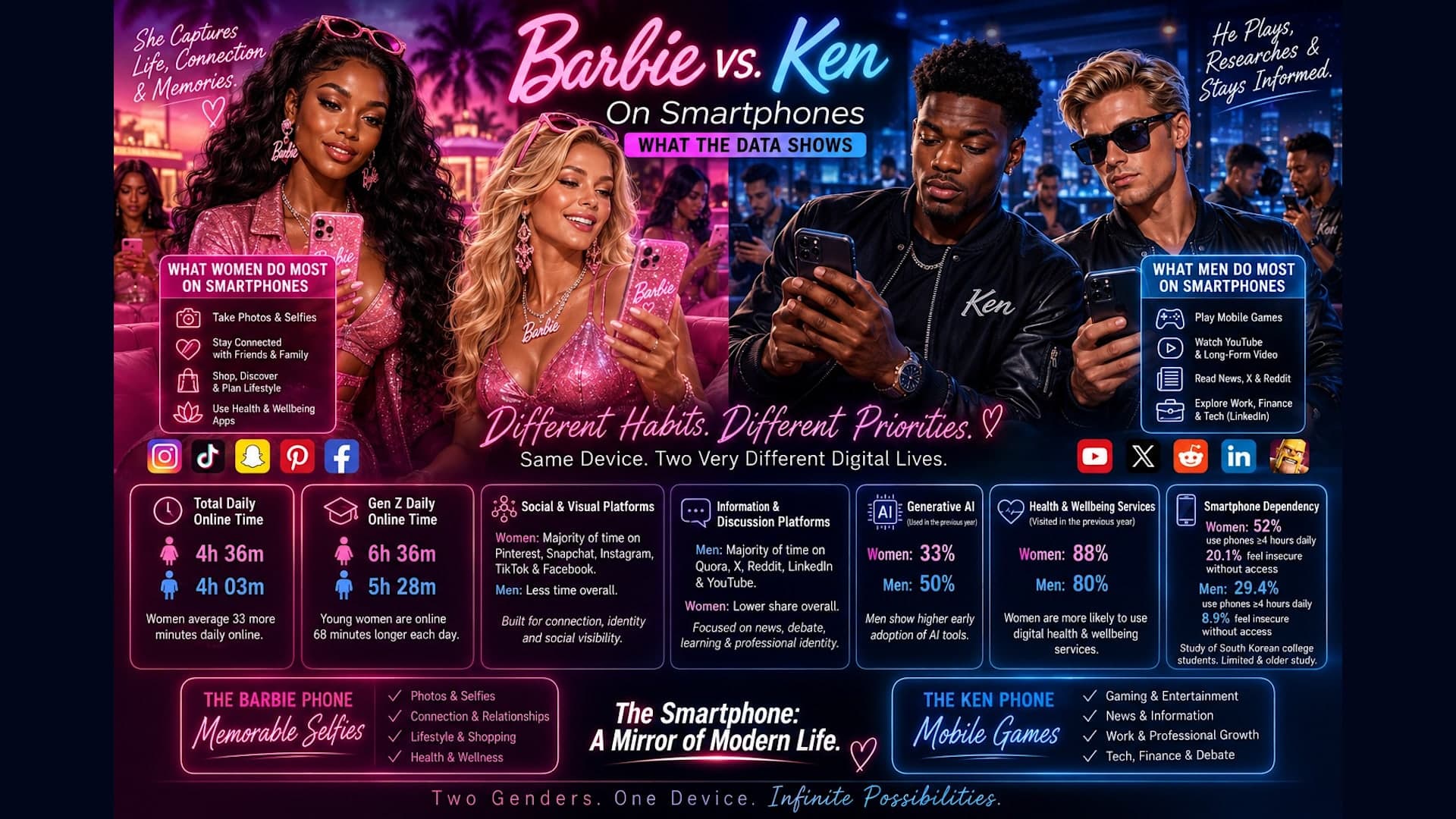
The Invisible Code of Socialization
The data tells a dramatic story: women log significantly higher total time online, dominated by social connection, health management, and community maintenance. A South Korean study highlighted that 52% of women spent at least four hours daily on smartphones compared to 29.4% of men. Rather than labeling this disparity as a simple "addiction," we must recognize it for what it truly is: structural digital labor.
Women have been socially programmed to handle the invisible labor of relationship-building, family care, and logistical coordination. The smartphone is merely their modern command center. Men, meanwhile, are pushed toward status, debate, and tool experimentation—driving a 50% vs. 33% surge over women in early generative AI adoption.
The Behavioral Divide in Data
Digital ArenaWomenMenThe Shocking RealityDaily Online Footprint4 hours 36 minutes4 hours 3 minutesWomen execute over half an hour more digital labor daily.Gen Z Screen Dominance6 hours 36 minutes5 hours 28 minutesThe digital divide is expanding rapidly among younger generations.Social vs. Utility EcosystemsPinterest (79%), TikTok (62%), Instagram (64%)Quora (70%), X (63%), Reddit (61%), LinkedIn (60%)Deep connection spaces vs. public debate and information gathering.Generative AI Frontier33% adoption50% adoptionMen are seizing early dominance over productivity and automation tools.
The Shockwave: Autonomous Vehicles and Domestic Robotics
If you think smartphone habits are jarring, prepare for the arrival of physical AI agents, domestic robots, and autonomous vehicles:
Self-Driving Vehicles: Autonomous transit will not be experienced equally. While men may evaluate autonomous vehicles for efficiency and productivity, women—who perform the vast majority of complex daily "trip-chaining" (errands, elder care, child drop-offs)—will demand vehicle architectures prioritized around multi-passenger safety, dynamic stop logistics, and personal security.
Robotic Household Care: As domestic robots enter our homes, they risk triggering a crisis of unpaid digital oversight. If women remain the primary managers of household upkeep, operating and troubleshooting complex robotic units will simply add another layer of uncompensated technical management to their daily workload.
The AI Skills Void: The early gender gap in generative AI adoption isn't just a quirk of user preferences—it is an economic disaster in the making. If male users continue to dominate early experimentation with AI tools, the resulting skills gap in automation, prompting, and algorithm construction will hardcode gender inequality directly into the future economy.
Smartphone habits are not random. They are a mirror reflecting who holds power, who carries the burden of care, and who builds the tools. As autonomous vehicles and robots take over our physical spaces, we must confront a critical reality: if we do not intentionally design technology to shatter legacy stereotypes, technology will permanently automate them.
Related articles



Thanks for reading.
More articles