Article
China Is Building the Operating System for Smart Cities. Is America Building Ours Fast Enough?
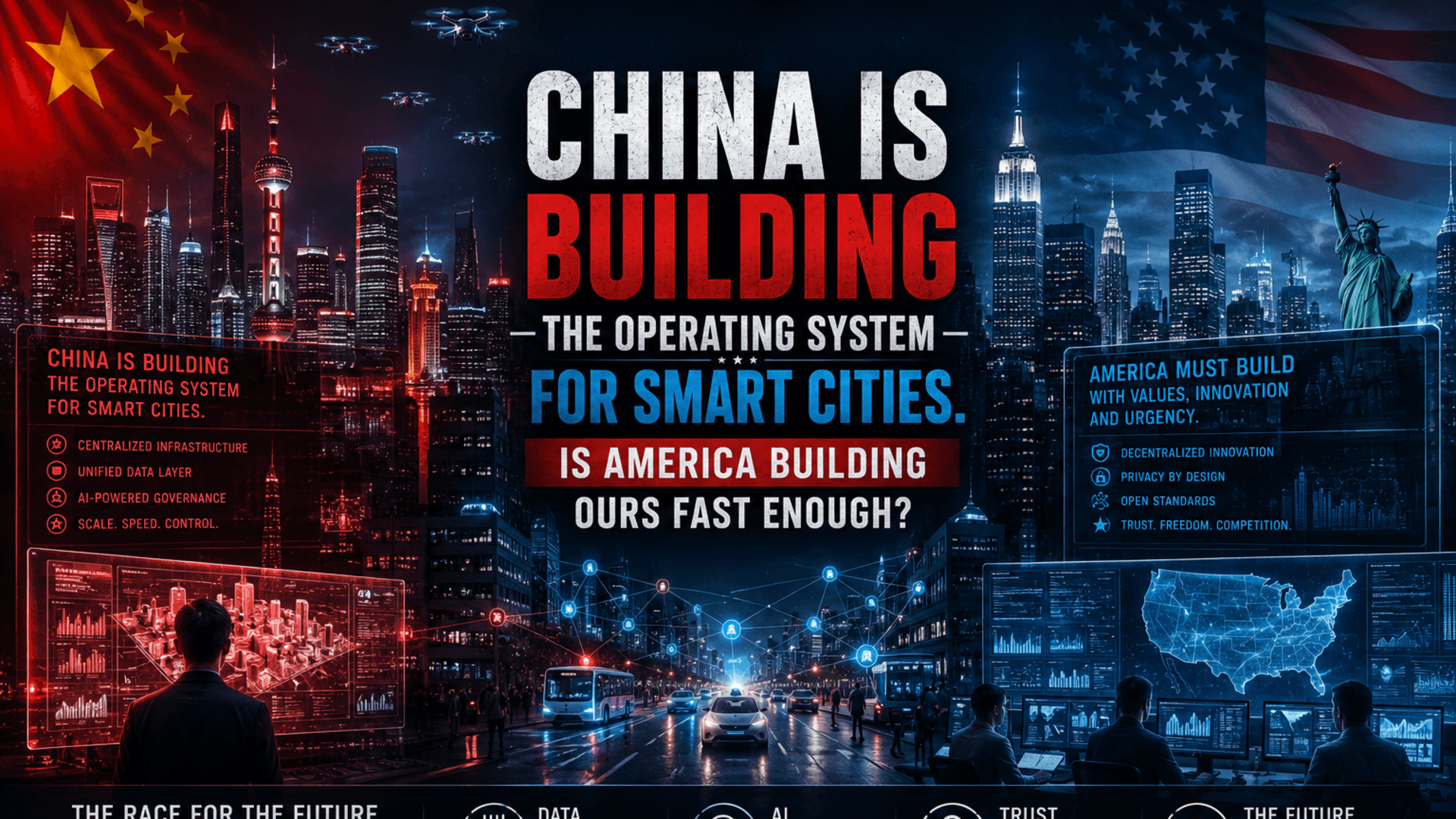
Shanghai is accelerating a citywide digital-economy strategy that combines AI infrastructure, computing power, next-generation communications, and blockchain deployment across finance, shipping, logistics, and green industries. Its goal is not simply to launch more apps—it is to make digital systems part of the operating infrastructure of the city and its economy.
Shanghai says blockchain use cases had already reached 60% of its economy by 2025 and has set a mandatory goal of adoption across key industries by 2030. The city is also expanding computing capacity and communications infrastructure to support AI at scale.
Why This Matters
The smart-city race is shifting from isolated technology pilots to integrated city systems.
China is connecting AI, data, logistics, mobility, finance, energy, and digital identity into coordinated long-term strategies. Shanghai’s approach treats data infrastructure and computing capacity much like physical infrastructure: essential assets that support commerce, public services, innovation, and competitiveness.
For U.S. cities, the question is no longer whether to become “smart.” The question is whether they can build trusted, interoperable, citizen-centered systems fast enough to keep up with cities that are planning their technology stack years in advance.
This is also a workforce issue. As cities deploy AI across transportation, public services, healthcare, utilities, and local business ecosystems, people need AI literacy—not just technical specialists. Residents, entrepreneurs, public servants, educators, and workers must be prepared to understand, use, question, and shape these systems.
China vs. America
AreaShanghai/China approachU.S. approachStrategyCity and national planning are closely aligned, with specific multi-year targets for digital infrastructure and industry adoptionThe U.S. has national AI and infrastructure priorities, but execution is more distributed across federal agencies, states, cities, utilities, universities, and private companiesAI infrastructureShanghai is explicitly expanding computing power, communication networks, and AI-enabled industry capacity as part of its city planAmerica’s AI Action Plan emphasizes accelerating innovation and building AI infrastructure, including computing, energy, and data capacity Smart-city deploymentTechnology is designed for integration into core sectors such as shipping, finance, logistics, and green developmentU.S. smart-city efforts often emerge as local pilots in mobility, connectivity, public safety, energy, and city servicesBlockchainShanghai has made broad adoption in key industries a concrete policy targetThe U.S. has significant blockchain innovation in the private sector, but no comparable nationwide or citywide adoption mandateFunding and governanceMore centralized coordination can speed infrastructure deployment and standard-settingThe U.S. has many funding and program channels, but they can be fragmented; one assessment identified nearly 50 federal programs that may support smart-city and broadband goals Public valuesDeployment can move quickly, but raises serious questions about surveillance, state control, and individual privacyU.S. cities have stronger legal and civic pressure around privacy, procurement transparency, equity, and civil liberties—though those guardrails can slow deployment
Do We Have This in Place?
Partly—but not as one unified national smart-city operating system.
America has many of the necessary components:
World-leading AI companies, cloud platforms, chips, research institutions, and startup ecosystems.
Federal attention to AI innovation, infrastructure, and international leadership.
Smart-city deployments supported through transportation programs, including advanced transportation and congestion-management technology initiatives.
Broadband, IoT, mobility, energy, and civic-technology investments across cities and regions.
A broad federal support landscape spanning research, deployment, connectivity, and community implementation.
What the U.S. often lacks is coordinated execution: common standards, durable public funding, interoperable data systems, scalable procurement, workforce preparation, and a clear local-to-national vision.
In other words, America has many of the parts. China is more aggressively assembling them into a city-scale system.
Message to U.S. Smart Cities
America should not copy China’s governance model. It should compete with a distinctly American model: innovative, locally responsive, privacy-protective, transparent, and built with communities—not simply deployed onto them.
U.S. smart-city leaders should focus on five priorities:
Build AI-ready infrastructure: affordable high-speed connectivity, reliable energy, cloud and edge computing access, secure data systems, and modern public technology.
Create interoperable standards so city agencies, transit systems, utilities, schools, hospitals, and local businesses can collaborate without locking residents into disconnected platforms.
Put people before sensors by requiring privacy protections, cybersecurity, public transparency, and meaningful community oversight.
Turn pilots into platforms by scaling proven solutions for traffic safety, transit reliability, permitting, emergency response, energy efficiency, and local economic development.
Make AI literacy a civic utility, ensuring workers, students, entrepreneurs, city employees, and community leaders can participate in the AI-powered economy rather than be left behind by it.
The real contest is not who installs the most sensors or deploys the most AI. It is who builds cities where technology makes daily life more affordable, mobile, safe, opportunity-rich, and human.
Related articles



Thanks for reading.
More articles