Article
Is This the New Crystal Ball?
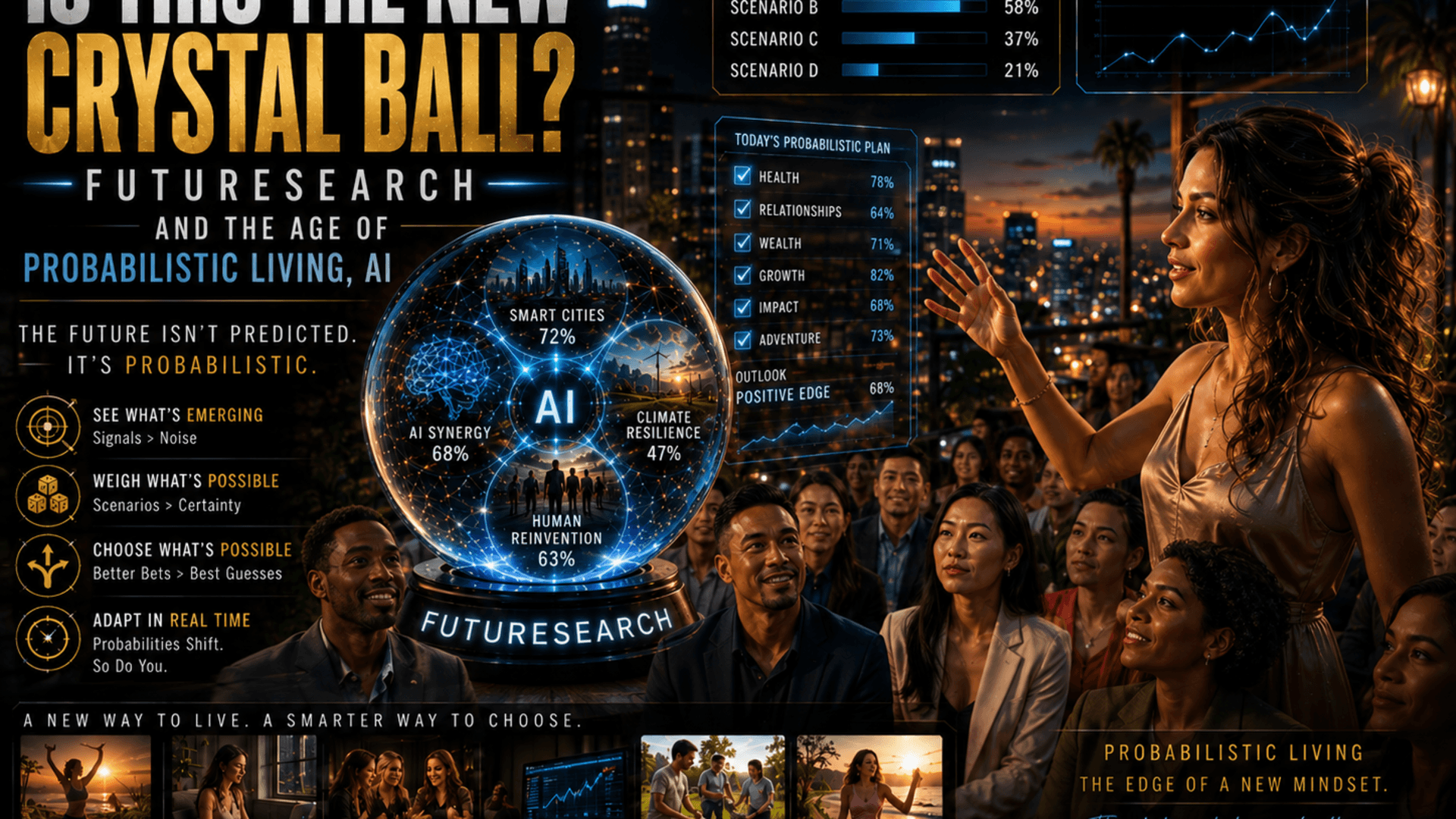
For centuries, people have searched for ways to see around the corner: horoscopes, experts, polls, financial analysts, intelligence briefings, and now artificial intelligence. FutureSearch enters that long tradition with a modern proposition: ask a question about the future and receive a forecast expressed through probabilities, numbers, and dates, supported by visible performance records across markets, prediction platforms, benchmarks, and forecasting competitions.futuresearch
But this is not really a crystal ball. A crystal ball claims certainty. A forecasting system, at its best, teaches something more valuable: the future is a range of possible outcomes, and better decisions come from understanding likelihood, uncertainty, and changing evidence.
How Humans May Predict
Tools like FutureSearch could shift prediction from a privilege of specialists to an everyday habit. A small-business owner might ask about demand; a city planner might weigh transportation scenarios; a family might consider relocation; an investor might test assumptions before acting. The real cultural change is not that software “knows” the future—it is that more people may begin to think in probabilities rather than absolutes.
That matters because humans often make decisions with overconfidence. We ask, “Will this happen?” A stronger question is, “What is most likely to happen, what would change that forecast, and what is the cost if I am wrong?” FutureSearch’s focus on measurable forecasts and a public record points toward accountability: predictions should be evaluated after the fact, not merely admired when they sound persuasive.futuresearch
How Humans May Move
Forecasting technology may change movement in both literal and social ways. In transportation, it could help people anticipate commuting patterns, weather disruptions, market shifts, and the pace of autonomous-vehicle adoption. In careers, it may help workers identify emerging skills and industries earlier—though no forecast should replace learning, relationships, or personal judgment.
The danger is that people could mistake a probability for a command. A 70 percent likelihood is not a guarantee; it still leaves meaningful room for another outcome. The most capable users will not simply follow a forecast. They will build flexible choices around it: keeping options open, setting checkpoints, and preparing for multiple futures.
How Humans May Judge
A forecasting assistant can make judgments feel more scientific, but it cannot make values disappear. A tool might estimate the chance that a policy reduces traffic or that a job sector grows. It cannot decide whether a city should prioritize equity, privacy, safety, freedom, or speed. Those are human choices.
This is where trust becomes essential. FutureSearch says its forecasts are supported by publicly visible results from several evaluation channels. That is a stronger standard than asking users to accept a prediction simply because it comes from A.I. Still, every user should ask: What evidence is behind this forecast? What incentives shape it? What uncertainty is missing? And whose interests could be affected if the prediction is wrong?futuresearch
The Crystal Ball Is Us
The most interesting possibility is not that A.I. becomes an oracle. It is that it becomes a mirror for human decision-making. It may reveal where people confuse confidence with accuracy, where intuition is useful, and where personal bias quietly drives a supposedly rational choice.
The new crystal ball should not tell humanity what to do. It should make people more disciplined about asking better questions, testing their beliefs, and acting responsibly under uncertainty. In that sense, FutureSearch may be less about predicting tomorrow than teaching people how to think before tomorrow arrives.futuresearch
What decision in your work or personal life would become stronger if you framed it as a probability-based forecast rather than a single yes-or-no prediction?
Related articles
Thanks for reading.
More articles