Article
Sidewalk Robots Are Changing More Than Food Delivery
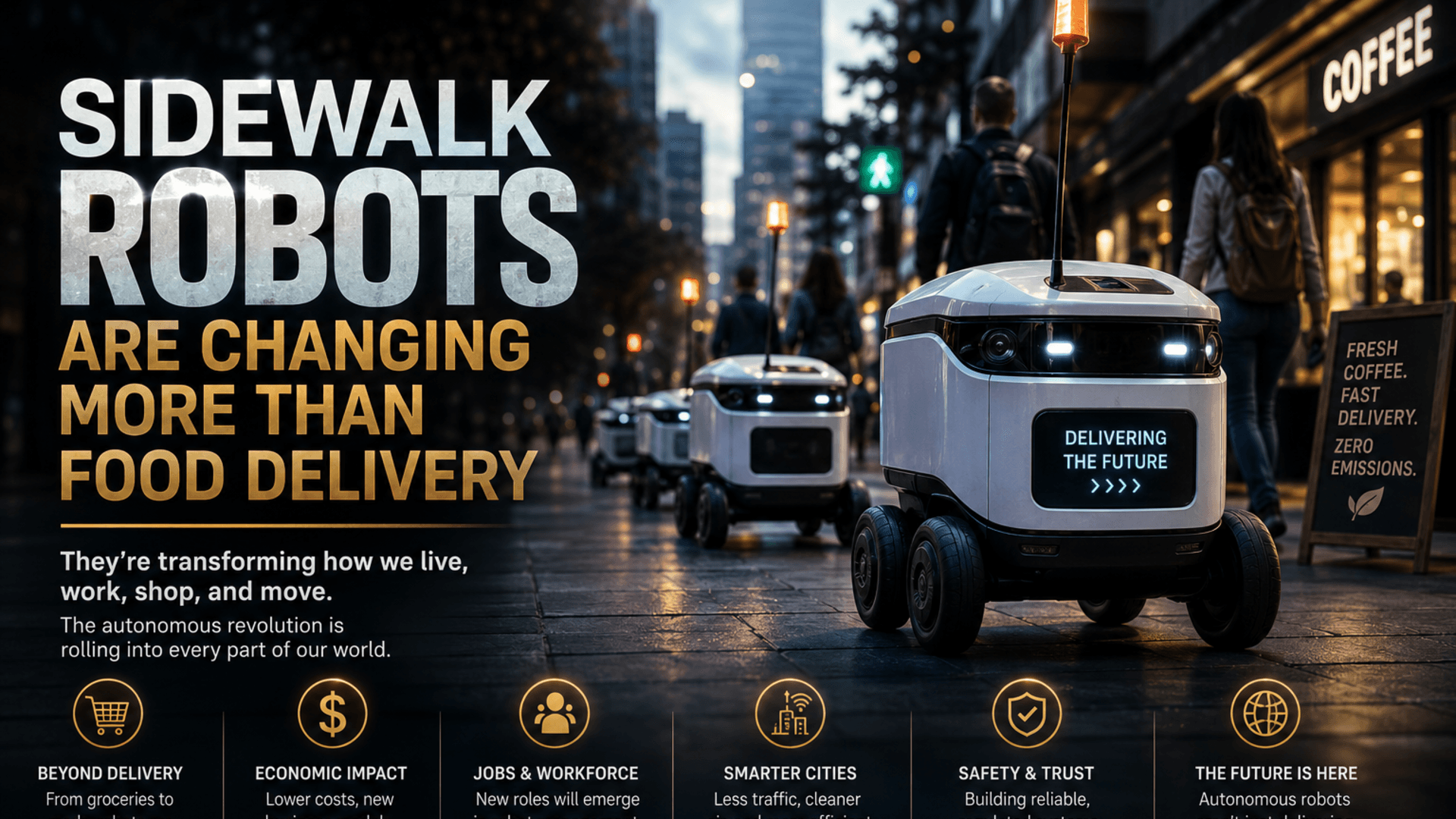
The next shift in consumer technology may not arrive in a smartphone, a vehicle, or a smart home device. It may arrive quietly on the sidewalk—carrying a coffee, a pizza, groceries, medicine, or everyday essentials.
Serve Robotics is expanding its autonomous delivery network through new partnerships with Grubhub and DoorDash, bringing sidewalk delivery robots to more neighborhoods in cities including Chicago, Los Angeles, Alexandria, Washington, D.C., and San Jose. The company is also establishing a Miami microdepot to charge, dispatch, service, and manage robots at scale. Serve says it now operates more than 2,000 robots and works with more than 4,000 restaurants nationwide.
This is not simply a story about cute robots replacing delivery drivers for short trips. It is a signal that autonomous services are moving from novelty to everyday infrastructure.
Why This Matters
Autonomous delivery changes the economics and expectations of local commerce. Restaurants have traditionally had three choices for delivery: employ drivers, rely on third-party gig workers, or ask consumers to pick up their own orders. Sidewalk robotics introduces a fourth model—an autonomous, digitally managed delivery layer designed for short-distance orders.
That matters because the “last mile” is often the most expensive and difficult part of delivery. A restaurant may prepare a meal in minutes, but getting it efficiently from the kitchen to a customer’s doorstep can involve labor costs, traffic, parking, fuel, weather, and delays. Autonomous robots can potentially handle repeatable, neighborhood-scale deliveries while allowing people to focus on higher-value service, operations, hospitality, and exception handling.
Serve’s new countertop device, Beacon, reflects how this technology is beginning to reshape restaurant workflows as well. It notifies staff when a robot arrives, reducing the need for employees to monitor an app or wait for a courier at the counter. In other words, the robot does not just change the delivery experience; it changes the restaurant’s operating system.
The Impact on Consumer Purchasing
When delivery becomes more accessible, reliable, and routine, people do not merely order the same products in a different way. They begin purchasing differently.
Consumers are likely to make more frequent, smaller purchases rather than consolidating needs into a single weekly grocery trip or larger food order. A customer may decide to order a single forgotten ingredient, an afternoon snack, allergy medicine, a phone charger, or a late-night meal because the friction of leaving home has been reduced.
This could create several consumer shifts:
Impulse purchasing may increase as delivery becomes fast enough to satisfy immediate needs rather than planned purchases.
Hyperlocal businesses gain a new channel to reach nearby customers without requiring those customers to drive, park, or wait in long lines.
Speed becomes an expectation, not a premium feature. Consumers will increasingly judge restaurants and retailers by how quickly and predictably they can fulfill an order.
Convenience becomes personalized. Customers may choose merchants based on robot-delivery availability, delivery window accuracy, and reduced fees.
Brand loyalty may shift toward platforms. If a consumer trusts a delivery app to consistently provide affordable autonomous delivery, the platform can become more influential than the restaurant or retailer itself.
For consumers, this is ultimately about time. Autonomous delivery gives people another way to reclaim minutes from errands and small tasks—especially in dense urban neighborhoods where short trips can still be inconvenient.
The New Behavior It Creates
The most significant impact may be behavioral: consumers will start designing their days around on-demand access.
Instead of thinking, “I need to stop at the store later,” people may think, “I can have it delivered when I need it.” That is a meaningful psychological shift from planned consumption to responsive consumption.
A few new behaviors are likely to emerge:
The doorstep pickup habit: Consumers will become accustomed to receiving small orders outside their home, office, hotel, campus building, or apartment complex.
Micro-ordering: Rather than buying in bulk, customers may purchase what they need for the moment—one meal, one item, one replacement, one forgotten necessity.
Real-time household replenishment: People may reorder essentials immediately when they run out instead of adding them to a shopping list for a later trip.
Delivery-first local discovery: Consumers may search nearby businesses based on whether they can deliver autonomously, quickly, and affordably.
A new trust relationship with machines: Customers will learn how to interact with robots, unlock compartments, respond to app alerts, and share sidewalks with autonomous devices.
The behavior change will extend beyond food. Serve is also introducing a new generation of its Moxi hospital robot at major health systems in Chicago and Los Angeles, showing that autonomous mobility is spreading into settings where time, logistics, and reliability are especially important.
The future is not just robots bringing burgers. It is autonomous systems moving supplies, supporting workers, reducing routine travel, and making physical services feel more like digital services: available on demand, trackable in real time, and increasingly automated.
Conclusion
Sidewalk delivery robots represent the early stage of a larger consumer transformation. As autonomous delivery expands, convenience will no longer mean simply ordering online. It will mean receiving what you need, when you need it, with less dependence on cars, parking, human couriers, and traditional store hours.
The companies that win in this environment will not be the ones that simply add robots for attention. They will be the ones that use autonomy to create a better customer experience: faster, more reliable, affordable, accessible, and human-centered.
For consumers, the question will not be whether they are comfortable with delivery robots. The real question will be how quickly robot delivery becomes so useful that it feels ordinary.
Related articles


Thanks for reading.
More articles