Article
The Humanoid Robot Takeover Has Begun: From Arena Showdowns to the Jobs That Power Our World
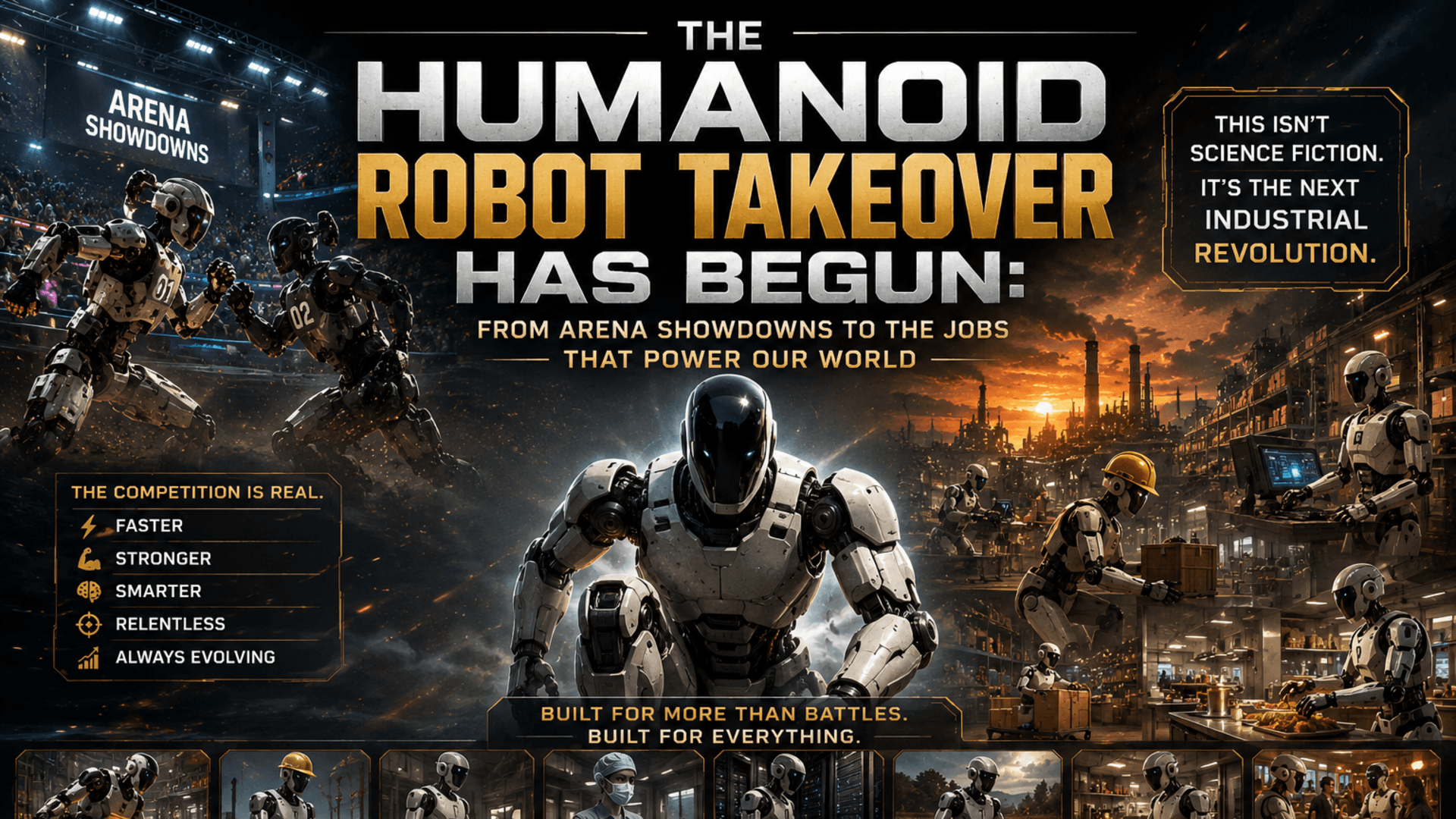
The next major test for humanoid robots is no longer whether they can walk, run, dance, or cross a finish line. It is whether they can complete meaningful work safely, reliably, and repeatedly in the environments where people actually live and work.
That transition is on display at the second World Humanoid Robot Games in Beijing, where 666 teams and 2,056 robots from 16 countries and regions are participating across 51 events. The sharp growth in participation—up 138 percent from the inaugural event—signals that humanoid robotics is moving beyond a novelty phase and toward a serious global race for commercial viability.globaltimes
A Shift From Spectacle to Utility
Humanoid robots have long captured public imagination. We have seen viral videos of machines dancing, doing backflips, serving food, and navigating obstacle courses. Those demonstrations matter because they show progress in mobility, balance, vision, and machine learning.
But the practical question is different: Can a robot load a printer, prepare a meeting room, sort books, assist in a home, respond in an emergency, or operate in a factory without creating more work for the humans around it?
This year’s Games are designed around that question. Competitions include industrial assembly, household services, logistics, emergency rescue, office support, and firefighting simulations. In one office-based task, humanoid robots must load printers, organize meeting supplies, and operate a paper shredder within 20 minutes. In another setting, robots are tested in real-world fire-response scenarios that require hazard detection, equipment operation, and coordinated decision-making.globaltimes
That is a more meaningful benchmark than simply making it to the finish line.
Infrastructure Is the Hidden Story
One of the most important developments may not be the competitions themselves, but the infrastructure being built around them.
Organizers created a “Robot Home,” essentially an athletes’ village for machines. It can house more than 1,500 robots and charge at least 1,200 batteries, while allowing digital check-in and retrieval of a robot in about 30 seconds. The event also uses a robot-specific competition command system and a management platform intended to coordinate robots from different brands and models.globaltimes
This matters because the future of robotics will not be determined only by how impressive a single machine looks onstage. It will be determined by the operational ecosystem around it:
Charging and battery-swapping systems
Maintenance and repair workflows
Fleet dispatch and scheduling
Safety monitoring
Cybersecurity and connectivity
Interoperability across manufacturers
Human oversight and accountability
In other words, humanoid robotics is becoming an operations challenge as much as an engineering challenge.
Why Dexterity May Decide the Market
The Games are also introducing a dedicated dexterous-hand competition, with eight precision events modeled on industrial and everyday tasks. That focus is significant.
Walking is visually impressive, but hands may be where humanoid robots prove their economic value. Many jobs require grasping, sorting, lifting, fastening, manipulating tools, handling fragile items, and working around unpredictable objects. A robot that can move through a space but cannot reliably handle objects has limited practical usefulness.
For manufacturers, warehouses, hospitals, hotels, retail operators, and home-service providers, dexterity could become one of the biggest differentiators in the humanoid robotics market. The winning robot may not be the one that moves most like a human; it may be the one that can safely complete a repetitive task thousands of times with minimal downtime.
The Workforce Question Is Here
As a futurist and AI educator, I see events like this as more than a technology story. They are a workforce story.
Humanoid robots are being trained for the same environments where millions of people work: factories, offices, warehouses, hotels, homes, hospitals, and public-safety settings. That does not mean every human worker will be replaced. But it does mean jobs will change.
Organizations need to begin preparing people for a workplace where robots may become teammates, assistants, tools, or, in some cases, substitutes for specific tasks. The priority should be helping workers build the skills that machines do not easily replicate:
Communication and relationship-building
Leadership and judgment
Problem framing
Creativity and adaptability
Robot supervision and exception handling
AI literacy, safety, and ethical decision-making
The most resilient workers will not simply compete against automation. They will learn how to direct it, audit it, repair it, improve it, and use it to create more value.
A Global Competition for Standards
The World Humanoid Robot Games could also help shape standards for the industry. When teams compete under common rules, testing methods, performance requirements, and safety expectations, those benchmarks can evolve into broader industry standards.
That is especially important as countries and companies race to build humanoid robots for commercial deployment. We need shared expectations around safety, reliability, data governance, interoperability, labor impact, and human accountability.
A humanoid robot operating in a warehouse, hospital, or home should not be judged only by its speed. It should be judged by whether it performs safely, respects privacy, avoids bias in its interactions, and operates within clear human-led rules.
Medals Are Not the End Goal
The real prize in humanoid robotics will not be a gold medal. It will be trust.
The companies that win in this market will be the ones that can convert technical demonstrations into dependable, affordable, secure, and useful products. They will need to show that their robots can deliver value in real conditions—not just controlled environments with cameras rolling.
The Beijing competition reflects a broader global turning point. We are moving from asking, “Can robots perform?” to asking, “Can robots work?”
That is the question businesses, educators, policymakers, and workers should all be preparing to answer now.
Related articles



Thanks for reading.
More articles