Article
The Kybalion, Four Initiates Behold, America and AI
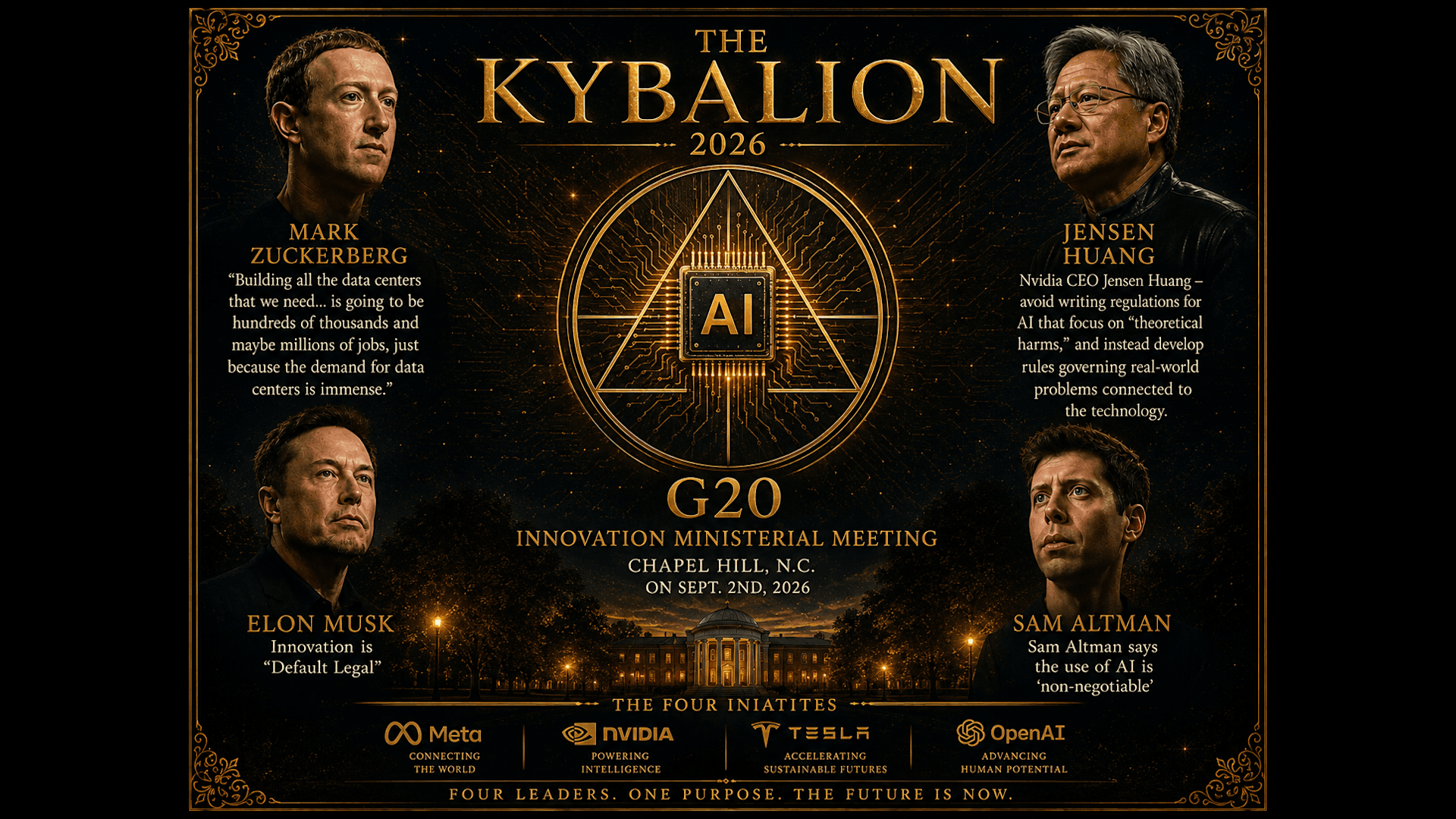
As the United States government and Big Tech leaders urge G20 member states to adopt a relaxed approach to AI regulation, the shift away from pre-emptive safeguards signals an era where rapid deployment takes precedence.
The Decrees of the Four Initiates
The philosophical framework presented by these four figures reflects an imperative to build fast and expand without regulatory friction:
Mark Zuckerberg (Meta): Advocates for massive physical expansion, asserting that constructing necessary data centers will require "hundreds of thousands and maybe millions of jobs" due to immense infrastructure demands.
Jensen Huang (Nvidia): Urges international delegates to avoid writing regulations for "theoretical harms," insisting instead on rules that strictly govern real-world problems connected to the technology.
Elon Musk (Tesla / xAI): Frames technological innovation as "default legal," criticizing European regulatory frameworks for inhibiting technical progress and economic output.
Sam Altman (OpenAI): Posits that the global integration and adoption of AI systems is "non-negotiable" for economic competitiveness.
America's Push for Deregulation
Co-hosting the G20 gathering, U.S. tech adviser Michael Kratsios called on international delegates to avoid crafting entirely new regulatory frameworks for artificial intelligence, urging policymakers to treat emerging technologies within existing legal paradigms rather than as isolated policy problems.
Policy FocusU.S. / Tech Leaders' ProposalDivergent / UN PerspectiveRegulatory ScopeFocus only on "novel" situations; avoid pre-emptive rules for theoretical harms.Establish strict international safety tests and guardrails immediately.Infrastructure & EnergyMassive buildout of data centers, energy systems, and compute capacity.High risk to security, societal stability, and human displacement.Economic GrowthAI as "default legal" to maximize productivity and global competitiveness.Current trajectory risks concentrating power among corporate architects.
Why This Matters: The Death of the Traditional Job
The shift toward treating AI as foundational infrastructure—akin to electricity or the internet—redefines the nature of human labor. When technological advancement is permitted to run ahead of regulatory safeguards, traditional job roles do not merely evolve; they face systematic displacement.
If global governments prioritize rapid compute growth while leaving workforce readiness as a secondary thought, the transition will favor those who control the infrastructure while leaving the broader labor market vulnerable.
The real question confronting the international community in Chapel Hill is not whether artificial intelligence will reshape global society, but whether humanity will retain agency over the economic reality being built around it. As these four initiates outline the blueprints for energy, data, and compute, civil leaders, educators, and policymakers must decide whether to actively shape these systems or simply adapt to the rules written for them.
Related articles



Thanks for reading.
More articles