Article
The Selfie Society: Women, Smartphones, Barbie, and the New Politics of Being Seen
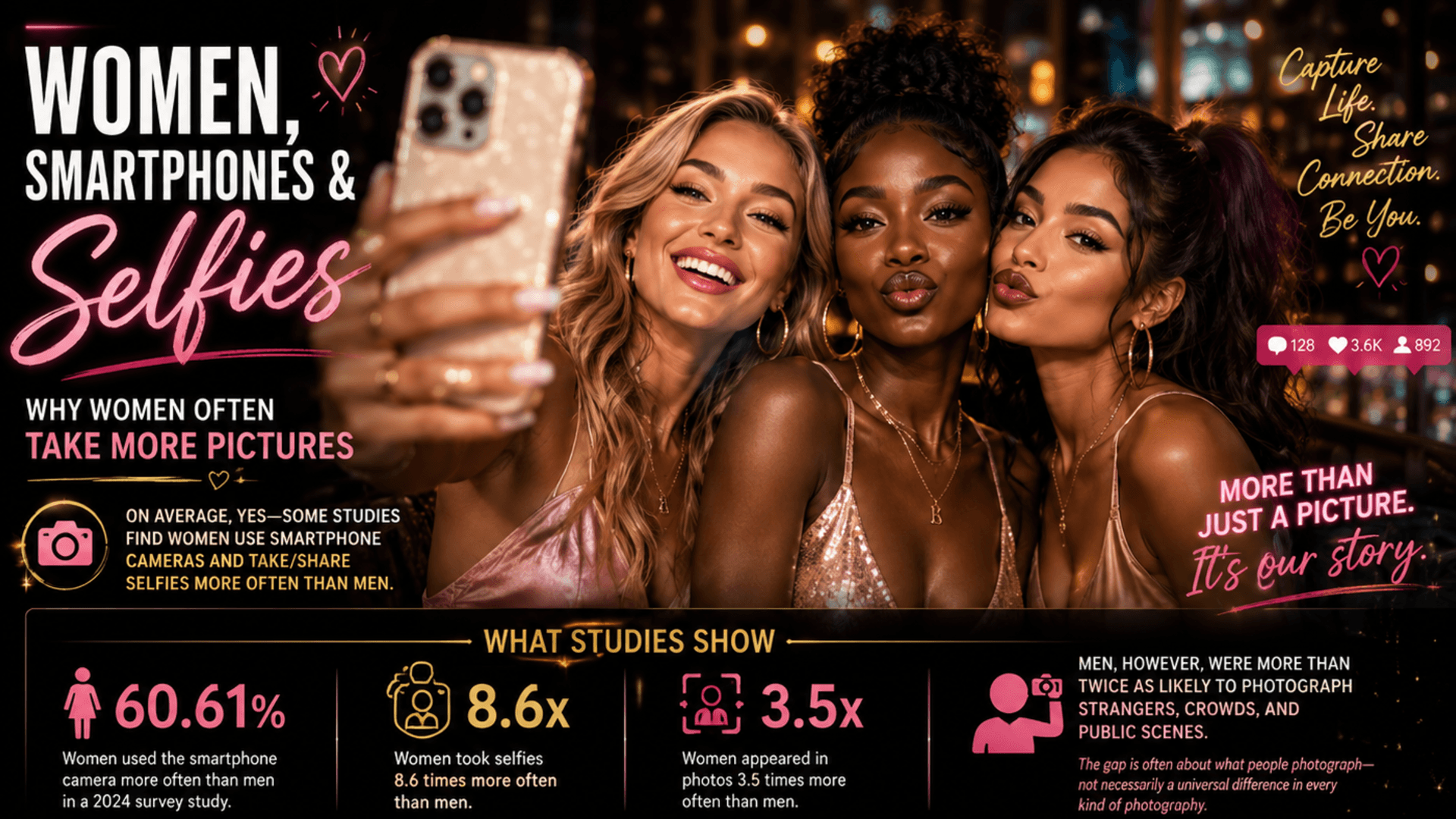
We are no longer just taking pictures. We are building visual identities, documenting belonging, selling aspiration, and quietly asking the world: Do you see me?
The smartphone turned every person into a photographer, publisher, editor, archivist, and brand manager. But it has not changed all of us in the same way. Research suggests women, on average, use smartphone cameras and take or share selfies more often than men—particularly for people-centered images and self-portraits. The deeper question is not whether women take more pictures. It is what that behavior says about gender, attention, memory, culture, and power in an image-driven society.
The selfie did not begin with Kim or Paris
The selfie is older than Instagram, smartphones, or celebrity culture. Oxford traces the word “selfie” to a 2002 Australian online forum, while the hashtag appeared on Flickr by 2004. The term entered mainstream culture around 2012 and was named Oxford Dictionaries’ Word of the Year in 2013.
But if technology supplied the tool, celebrity culture supplied the blueprint.
Paris Hilton famously claimed that she and Britney Spears “invented the selfie” through their widely circulated 2006 camera-facing photos. That is best understood as a pop-culture claim—not a literal historical fact. Still, Paris Hilton’s influence was real: she helped normalize the idea that simply being visible, photographed, stylish, and socially present could be a form of media power.
Kim Kardashian scaled that concept. Alongside Hilton, she helped usher in the influencer era, turning paparazzi logic into an always-on personal-media strategy. Kim did not invent self-portraiture, but she helped turn the selfie into a business model: image as currency, attention as distribution, and personal visibility as enterprise.
The shift was profound. Before social media, celebrities were photographed primarily by other people. The smartphone gave individuals the ability to become their own photographer, publicist, and publisher.
Women use the camera differently
A 2024 study of university students found women were more likely than men to use the smartphone camera; women comprised 60.61% of the camera users in that study.
An analysis of 5,000 images from smartphone camera rolls found that women took selfies 8.6 times more often than men and appeared in photos 3.5 times more often. Men were more than twice as likely to photograph strangers, crowds, and public scenes.
QuestionWomen, on averageMen, on averageMore likely to use the smartphone camera?Yes, in at least one 2024 survey sample. Less often in that sample. More likely to take and share selfies?Yes, research generally finds higher selfie posting among women. Less likely on average, though participation is widespread.Common image focusSelf, friends, relationships, celebrations, personal moments. Crowds, strangers, scenes, events, objects. Common social functionConnection, memory-making, identity, expression, and visibility.Documentation, activities, environment, interests, and events.
These are not rules. Plenty of men take daily selfies, build image-based brands, and use social platforms with sophistication. Plenty of women rarely post or take photos. But the aggregate pattern points to a meaningful cultural difference: women are often encouraged to be both the keeper of memories and the subject of them.
The Barbie effect
The 2023 Barbie film did more than fill theaters. It turned pink into a digital language. Barbiecore sparked more than 7 million social-media mentions and more than 227 million engagement actions in 2023, while “Barbiecore outfit ideas” generated more than 11 million TikTok views.
That wave invited millions to photograph themselves in pink outfits, curated settings, themed parties, and stylized poses. It gave people permission to play with hyper-femininity, nostalgia, glamour, and friendship in public.
But the Barbie effect is complicated.
Barbie can be a symbol of confidence, career ambition, friendship, imagination, and self-authorship. At the same time, research and criticism have long raised concerns about Barbie’s impossible proportions, body-image pressure, objectification, and appearance comparison. A recent scholarly review notes these longstanding critiques while also recognizing that the 2023 film created a broader cultural conversation than the doll alone.
The smartphone intensifies that tension. It lets a person define her own image—but it also exposes that image to algorithms, comments, comparison, beauty filters, trends, and invisible engagement metrics.
Hot Girl energy and the right to be visible
Megan Thee Stallion’s “Hot Girl Summer” culture amplified another version of image ownership. Its core message was not simply “look hot.” Megan described it as women and men being unapologetically themselves, enjoying life, hyping up friends, and refusing to be governed by outside judgment.
That is a powerful corrective to older expectations that women should be attractive but not too confident, expressive but not too visible, ambitious but not too self-promotional.
The “Hot Girl” look—and the photos that come with it—can be read as a declaration: I control the camera angle. I choose the outfit. I name the moment. I decide how I am seen.
Yet empowerment and pressure can coexist. A person can feel liberated by self-expression while also feeling compelled to keep up with poses, filters, body ideals, luxury signals, and an always-photogenic lifestyle. The same phone that offers agency can turn identity into a nonstop performance review.
Barbie, Ken, and the gendered camera
The Barbie narrative offers a useful metaphor for social media. In many visual spaces, women are expected to be “Barbie”: styled, expressive, emotionally available, socially fluent, and visually prepared. Men are often allowed to play “Ken”: present, supportive, funny, accomplished, or simply adjacent to the scene.
That does not mean men are powerless or invisible. It means the standards can differ. Women are frequently judged more intensely on appearance, age, clothing, body shape, and presentation. Men may face pressure to project status, fitness, success, humor, confidence, or lifestyle—but they are often given more latitude to be visually casual.
This may help explain why women are more practiced at the social rituals around photographs: choosing locations, coordinating outfits, finding lighting, retaking pictures, curating a carousel, and ensuring every friend feels included. What appears frivolous can actually be emotional labor, social intelligence, image literacy, and community building.
Humanity’s exploding camera roll
Photography is now one of humanity’s most common daily behaviors. Estimates place global photo creation at about 2.1 trillion images in 2025—roughly 5.3 billion a day or more than 61,000 every second. Smartphones accounted for an estimated 94% of photos taken in 2024.
If current growth trends continue, annual photo creation could approach 3 trillion images by 2030, with at least 30 trillion photos potentially existing worldwide by then. These forecasts are estimates, not certainties—and generative AI could make the number of images created, shared, and remixed much larger.
The implications go beyond storage space. We are creating a civilization-scale visual archive: birthdays, meals, graduations, protests, babies, gym sessions, concerts, grief, joy, and evidence of ordinary life.
But we should ask: are we preserving life, or interrupting it to prove it happened?
What the selfie reveals
Women may take more pictures on average because photos often function as connection, identity, memory, relationship work, and self-expression. Men may take fewer selfies while using the camera more often to capture activities, crowds, landscapes, objects, and events.
Neither approach is inherently superior. The point is that the smartphone camera reveals what each of us has been taught to value and perform.
The selfie can be narcissism. It can also be memory. It can be insecurity. It can also be confidence. It can be commercialized beauty pressure. It can also be a person claiming the right to exist visibly, especially in a culture that has historically controlled who gets to be pictured, admired, and remembered.
By 2030, when trillions more images will exist, the real issue will not be whether we take too many pictures. It will be whether we still know how to live moments that do not need to be photographed—and whether technology helps people tell fuller, freer stories about themselves rather than forcing everyone into the same pose.
Related articles


Thanks for reading.
More articles