Article
The Soul Sold to the Machine? Why Mary J. Blige’s AI Deal Changes Everything
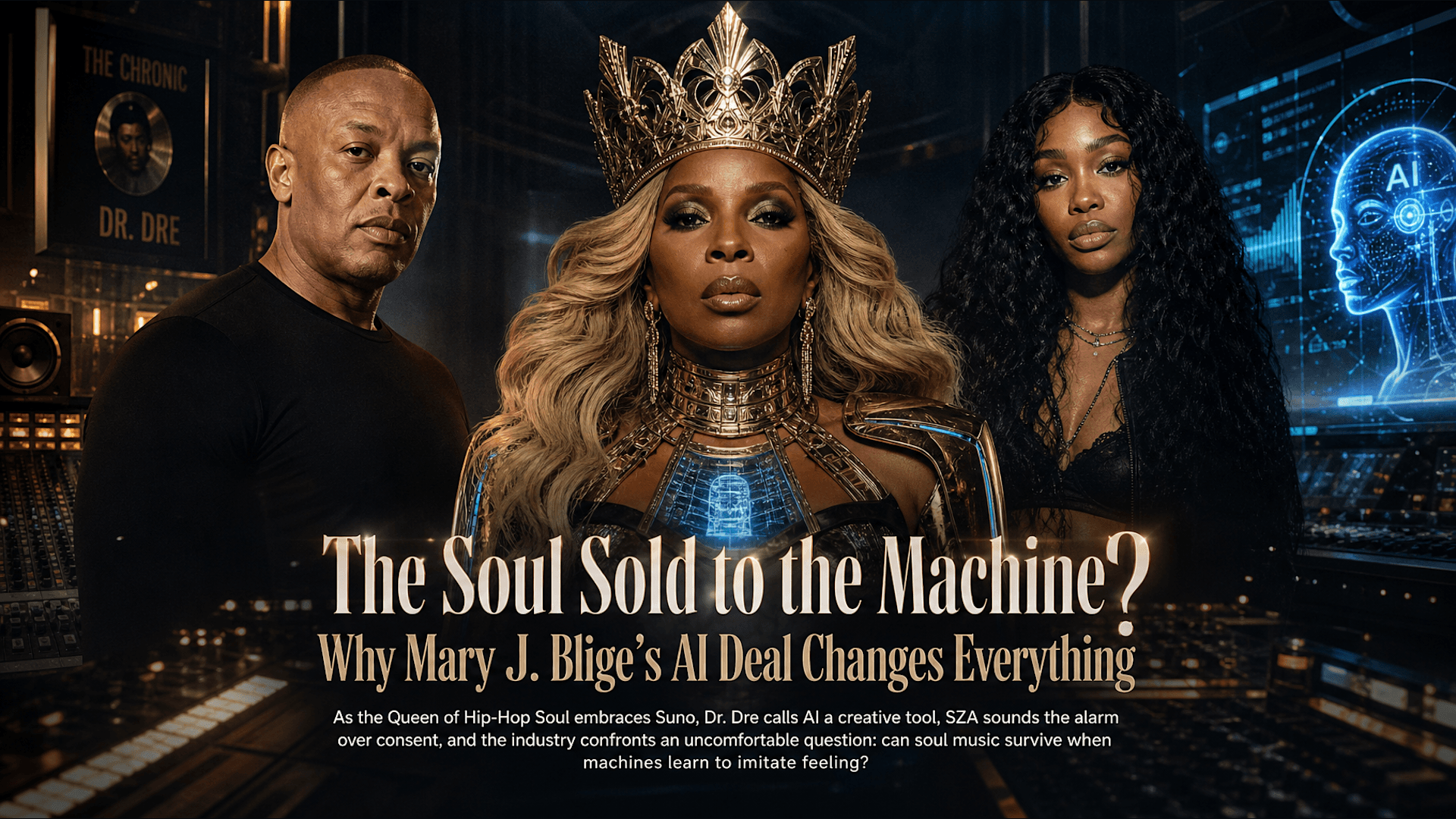
Mary J. Blige built her legacy on the things that cannot be programmed: heartbreak, faith, pain, survival, self-worth, healing, and the hard-earned confidence of a person who has lived through the lyrics.
That is why her reported multimillion-dollar promotion deal with AI music platform Suno is not just another celebrity-tech partnership. It is a cultural turning point.
The Queen of Hip-Hop Soul is stepping into an industry-wide battle over artificial intelligence at the exact moment artists, producers, labels, fans, and technology companies are fighting over who owns music, who gets paid for it, and whether human creativity is becoming raw material for machines.
Mary’s move places her on one side of a widening debate with two other major voices from the culture: Dr. Dre, who sees AI as a new creative tool artists should learn to use, and SZA, who sees AI music as a threat to consent, ownership, and the creative legacy of artists—particularly Black artists—whose work may be used to train these systems.yahoo+1
The fight is not simply about whether AI can make a song.
It can.
The fight is about whether the next chapter of music will empower human creators—or quietly replace them.
Mary J. Blige: AI as Access
Mary J. Blige’s association with Suno gives generative music something that technology companies cannot build in a lab: trust from the culture.
Suno enables users to turn prompts, lyrics, moods, and basic creative ideas into polished songs. A person can describe an R&B ballad about loss, write a few lines of poetry, choose a musical direction, and receive a complete track with melody, production, instrumentation, and vocals.
For people shut out of traditional music-industry infrastructure, that is a major shift.
For decades, the ability to create professional-sounding music depended on access to expensive studios, engineers, musicians, producers, record-label relationships, equipment, and capital. AI tools can lower those barriers, putting music creation within reach for people who may have vision but lack the resources to fund a traditional recording process.
That is the promise behind Mary’s endorsement.
A young person in a bedroom can experiment with songwriting. A spoken-word artist can hear their words transformed into a musical idea. A creator can develop a demo before spending money on a studio. An independent filmmaker can test early soundtrack concepts. An entrepreneur can create a campaign sound without waiting for gatekeepers to say yes.
Mary’s perspective, at least in the way the partnership is being presented, is rooted in creative possibility.
AI can become a doorway.
But SZA’s critique asks a question that must come before everyone walks through it:
Who built the doorway, whose work was used to build it, and who owns what comes out on the other side?
Dr. Dre: Learn the Tool
Dr. Dre is among the most prominent artists embracing AI in music. In an interview with The New York Times, he called AI “a new tool for creativity,” rejected the idea that it is inherently a threat, and compared opposition to AI with earlier skepticism around drum machines and synthesizers. Dre said he is already using AI in his own process to see what the technology can do with his work.billboard
That point should not be dismissed.
Music has always evolved with technology.
The drum machine did not destroy rhythm. It helped create new forms of funk, pop, dance, R&B, and hip-hop.
Sampling did not end musicianship. It became one of hip-hop’s foundational languages, creating new art from fragments of musical memory—while also forcing the industry to develop rules around clearance, copyright, and compensation.
Digital audio workstations did not eliminate producers. They gave more people the ability to record, arrange, edit, mix, and release music independently.
Auto-Tune did not end singing. It became an artistic effect, an engineering tool, and a sound that shaped an era.
From Dre’s perspective, AI is the next instrument.
His warning is directed at artists who refuse to learn it. He argues that people who see AI only as a threat risk repeating the fear that met every major music technology before it became normal. He has gone as far as saying that those most threatened by AI may be the people who have difficulty creating.billboard
For a gifted producer, AI may be useful as a sketchpad, collaborator, research assistant, sound-design tool, arrangement experiment, or way to rapidly explore an unfinished idea.
But this is where the analogy begins to break down.
A drum machine does not require millions of copyrighted songs to learn how music works.
A synthesizer does not absorb a generation of singers, writers, musicians, and producers before generating an imitation of their creative labor.
Generative AI may be an instrument—but it is also an instrument trained on culture.
That changes the stakes.
SZA: Consent Before Celebration
SZA’s position is not based on fear of new tools. It is based on a demand for consent.
She has publicly attacked AI music after learning that an AI music database reportedly listed 238 of her songs as training material, including tracks she believed might be unreleased. Her objection is direct: artists should not be asked to celebrate technology built from their work if they were never asked for permission, never credited, and never paid.yahoo+1
SZA’s critique goes even deeper than copyright.
She has argued that Black artists are especially vulnerable in this moment because Black music has shaped global sound while frequently being copied, commercialized, diluted, and monetized by people and institutions that do not fairly compensate its originators. In her view, AI risks scaling that history into a new kind of extraction: teaching systems to reproduce the textures, cadences, emotional language, and musical traditions of Black creativity without returning value to the people who created them.rollingstone
Her concern is also artistic.
SZA has criticized what she sees as stereotypical versions of Black music produced by AI systems—music that can mimic the surface-level aesthetics of pain, struggle, gospel, R&B, hip-hop, or soul without holding the experience that gave those traditions their meaning.facebook
That is the central conflict of the AI era.
A machine can learn the sound of soul.
But can it understand the soul behind the sound?
Can it understand why a vocal crack matters?
Can it understand the difference between pain performed and pain lived?
Can it understand a church harmony, a blues progression, a protest song, a love song, or a survival anthem as more than patterns in training data?
SZA’s answer is clear: human experience is not a dataset.
The AI Music Collision
Mary J. Blige, Dr. Dre, and SZA represent three essential—but competing—visions of AI’s role in music.
VoiceAI perspectiveWhat matters mostCentral risk they highlightMary J. BligeAI can broaden access to music creationGiving more people tools to turn ideas into songsCreative access becomes a corporate shortcut rather than an artist opportunityDr. DreAI is a new instrument for creative experimentationArtists learning and directing the technology instead of fearing itFear of innovation limits the next evolution of musicSZAAI must not be trained or monetized without artist permissionConsent, ownership, compensation, cultural integrity, and human experienceArtists’ work and Black cultural expression are extracted, imitated, and devalued
Mary represents possibility.
Dre represents adaptation.
SZA represents protection.
The music business will fail if it chooses only one.
If the industry listens only to Mary and Dre, it may celebrate innovation while ignoring who paid the hidden cost of training the machine.
If it listens only to resistance, it may miss meaningful ways AI can help independent artists, songwriters, educators, and creators gain access to tools once reserved for people with money and industry connections.
The solution is not to choose between creativity and protection.
The solution is to demand both.
The Multimillion-Dollar Warning
The broader AI-music controversy includes the rise of virtual artists receiving significant commercial attention and reported record deals. That development has triggered musician backlash because it suggests labels and investors may be prepared to fund synthetic or AI-assisted performers while human artists still struggle for fair pay, visibility, and creative control.ecr.co
That should concern every working creative.
A record label may see a synthetic artist as a low-risk asset: no touring demands, no aging, no personal scandal, no public disagreements, no requests for masters, no publishing disputes, no scheduling conflicts, and no need to negotiate traditional artist power.
A brand may see AI music as a way to avoid licensing fees.
A streaming platform may see an endless supply of mood-specific tracks that are inexpensive to produce.
A marketing agency may see a shortcut to creating music with the “energy,” “feel,” or “vibe” of a well-known artist without paying that artist.
But a musician sees something else:
A future in which “good enough” synthetic music is used to eliminate the jobs that once helped artists build sustainable careers.
That includes songwriters, studio engineers, background vocalists, instrumentalists, arrangers, composers, producers, session players, and independent artists who rely on licensing, commissions, gigs, and royalties.
The danger is not that AI will make a few novelty songs.
The danger is that the business side of music will decide that humanity is too expensive.
The Future of Soul Music
Soul music has never been only a genre.
It is a form of testimony.
It comes from the blues, gospel, jazz, R&B, funk, hip-hop, church traditions, neighborhood stories, family struggle, cultural memory, and personal truth. It carries the sound of people turning hardship into beauty.
That is why the future of soul music cannot be measured by whether AI can make a convincing slow jam.
It can likely learn the ingredients: warm chords, layered harmonies, a gospel-inspired progression, a vintage drum break, a vulnerable lyric, a vocal run, and a late-night atmosphere.
But soul is not simply the arrangement.
Soul is the reason the arrangement exists.
The future of the genre will depend on whether artists maintain control over the stories, voices, and cultural traditions that AI systems are being trained to imitate.
The best future is not one where AI replaces soul music.
It is one where AI helps more people discover their own voice—while human artists retain ownership of their voices, names, likenesses, songs, and stories.
That requires clear rules:
Artists must be able to consent to or refuse the use of their music, voice, image, and likeness in AI systems.
Commercial AI models should use licensed training data and compensate rights holders.
Music platforms should disclose whether songs are human-made, AI-assisted, or substantially AI-generated.
Labels and technology firms should not use AI as a hidden strategy for cutting human creative labor out of the business.
Artists need education on voice rights, AI licensing, contracts, attribution, royalties, and ownership.
Fans deserve transparency about whether they are listening to a human performance, an AI-generated performance, or a blend of both.
The Soul Is Still Human
Mary J. Blige’s embrace of Suno signals that AI has arrived at the center of popular music.
Dr. Dre’s enthusiasm reminds creators that new tools can create new art.
SZA’s anger reminds the industry that technology without consent is not progress—it is appropriation at scale.
The culture needs all three perspectives.
We should not fear tools simply because they are new. But we should never allow the excitement of innovation to erase the people whose talent, pain, genius, and lived experience created the culture in the first place.
Artificial intelligence may produce a melody in seconds.
It may generate a beat that resembles an era.
It may imitate the sounds of gospel, hip-hop, blues, R&B, jazz, and soul.
But it cannot carry the life behind the lyric.
It cannot survive the story behind the vocal.
It cannot feel the pain, the praise, the grief, or the joy that makes a song more than content.
The machine may learn the sound of soul. But the soul still belongs to the people.
Related articles

Thanks for reading.
More articles