Article
The Verdict: Higher Education is Dead (And AI is the Executioner)
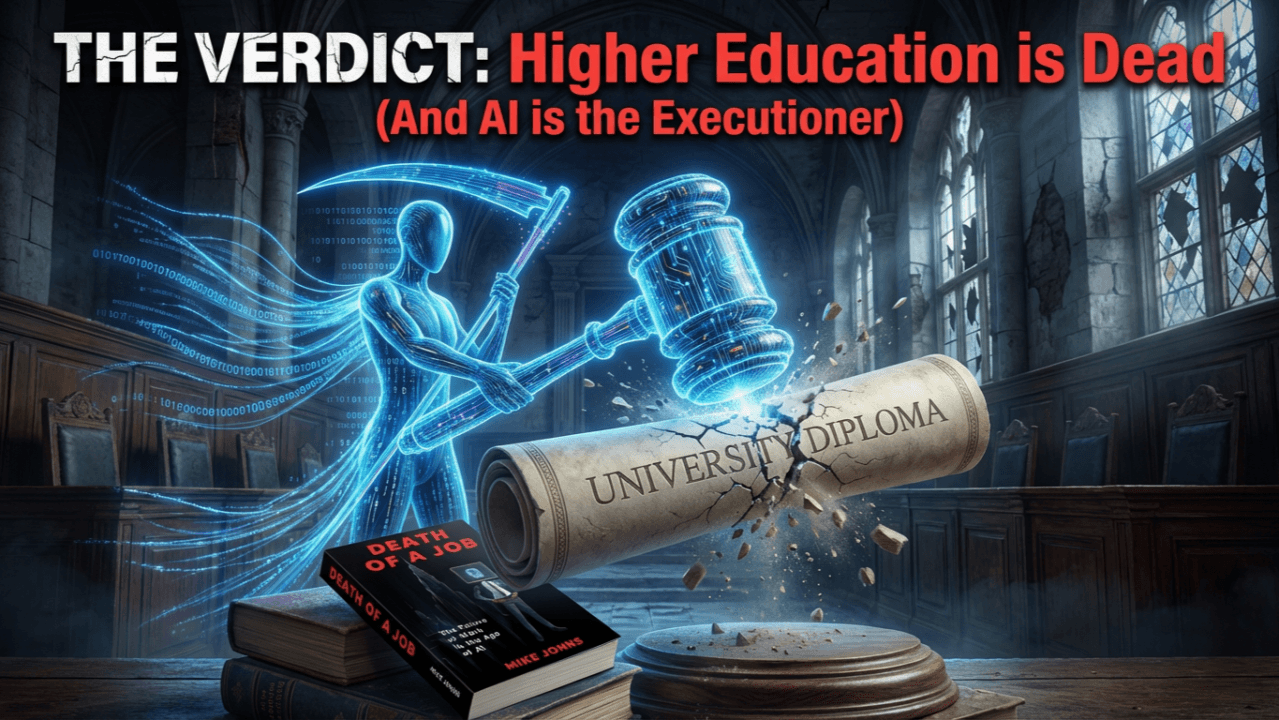
The Great Unbundling: A Market Shift
For a century, universities sold a "bundle" of signaling, sorting, and socializing. Today, AI has ripped that bundle apart. When world-class tutoring is available for $20 a month, the $200,000 lecture hall becomes a historical relic.
See content credentials

Artwork By Mike Johns
The "Two-Sigma" Revolution
In 1984, researcher Benjamin Bloom found that students tutored one-on-one performed two standard deviations (two sigma) better than those in a classroom. This gold standard was once a luxury for the elite.
The Shocking Data:
80-90% of students globally now report using Generative AI for their studies.
AI provides the "patient tutor" at near-zero marginal cost, effectively scaling the "Two-Sigma" advantage to anyone with a smartphone.
The result? The "average" university—which relies on passive lectures—is now providing a product that is objectively inferior to a motivated student with an AI co-pilot.
The Four New Species of Higher Ed
As the "Death of a Job" accelerates, the university landscape is fracturing into four distinct categories. If an institution isn't a Cathedral or a Lab, it’s likely a Zombie.
1. The Country Clubs (Elite Brands)
These schools are in the "Status & Network" business. Their value is the gate they keep, not just the books they teach.
Harvard, Yale, & Princeton: The "Holy Trinity" of the Ivy League. You aren't just buying a degree; you’re buying a lifetime membership to the global power structure.
The M7 Business Schools (Wharton, Stanford GSB, Columbia, etc.): These are the ultimate professional Country Clubs. You go here specifically to meet the person who will fund your startup or hire you as a CEO.
Stanford & MIT: While they have incredible "Toolbox" assets, they function primarily as the Gilded Gates to Silicon Valley and the world of high-tech venture capital.
2. The Toolboxes (Physical Assets)
These schools own the physical "bottlenecks" of reality. You go here because you need their labs, hospitals, and machines.
Johns Hopkins University: The gold standard for medical training. You can't simulate their relationship with the Johns Hopkins Hospital or their high-end pathology labs.
Georgia Tech & Caltech: They own the massive wind tunnels, robotics bays, and clean rooms that a student simply cannot access anywhere else.
Texas A&M / Purdue: Known for massive engineering "foundries" and agricultural research centers that require boots on the ground and hands on a wrench.
Mayo Clinic College of Medicine: A school literally built inside one of the world's best hospitals.
3. The Fast Lanes (Career Engines)
These institutions have ditched the "four-year-wait" in favor of high-speed, industry-direct results.
Pima Community College: A leader in "earn-while-you-learn" models, partnering directly with companies like Raytheon and Caterpillar to build apprenticeships.
Western Governors University (WGU): The pioneer of the "competency-based" model. If you already know the skill, you pass the test and move on immediately. No waiting around for a semester to end.
UT Austin (via Micro-credentials): They now offer modular AI and Data Science certificates (like their collaboration with Great Learning) designed to be "stacked" into a career in months, not years.
General Assembly / Lambda School: While not traditional colleges, these "bootcamps" were the original Fast Lanes, trading liberal arts for 12 weeks of intense coding.
4. The Blockbusters (The Walking Dead)
These are mid-tier schools with high tuition and low "brand signal." They are at high risk of disappearing as students realize they can get the same content online for free.
Small Private Liberal Arts Colleges (Various): Think of the dozens of small colleges in New England (like the recently closed Hampshire College or Birmingham-Southern) that struggle with tiny endowments and high overhead.
Mid-Tier State Satellites: Think of a "Directional State University" (e.g., Western-North-Central State) that offers the same general business degree as 500 other schools but lacks the prestige of a "Country Club" or the specific facilities of a "Toolbox."
Struggling Private Masters Universities: Schools like Brandeis or Lesley University have recently faced massive budget cuts and "zombie-like" financial status due to declining enrollment and a product that feels increasingly overpriced for the "signal" it provides.
Evidence is the New Currency
In an AI-saturated world, saying "I have a degree" is a weak claim. Employers are shifting from credential-based hiring to evidence-based hiring.
Marketers must show campaigns, not transcripts.
Developers must show GitHub repos, not CS degrees.
Analysts must defend live dashboards, not pass multiple-choice tests.
The "Death of a Job" means the death of the "compliant student" path. The new "degree" is issued by reality, through repeated cycles of building, shipping, and defending work. 🛠️
The UNESCO Reality Check
While UNESCO issues global guidance on AI ethics and human-centered policies, these are "guardrails," not "lifeboats." Policy can regulate how AI is used in a classroom, but it cannot stop the economic collapse of a business model that sells scarce information in an age of infinite abundance. 🌍
The Takeaway for 2026
Stop asking "Should I go to college?" and start asking "What proof can I produce?" If a university doesn't help you build a portfolio that AI can't fake, you aren't a student—you're a customer at a closing sale.
Next Step: Audit your current path. If your "value" is based on a diploma rather than a demonstrable skill, you are currently holding a ticket for a ship that has already hit the iceberg.
Related articles

Thanks for reading.
More articles